Readings Newsletter
Become a Readings Member to make your shopping experience even easier.
Sign in or sign up for free!
You’re not far away from qualifying for FREE standard shipping within Australia
You’ve qualified for FREE standard shipping within Australia
The cart is loading…


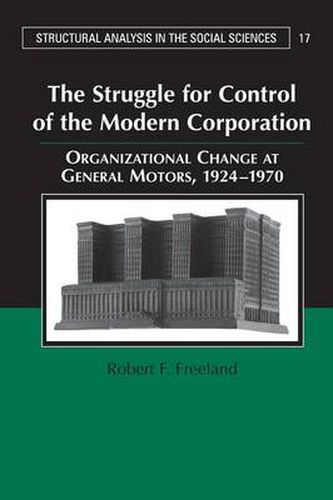
Winner of the 2005 Business History Review Newcomen Award for best book in business history, The Struggle for Control of the Modern Corporation provides a fascinating historical overview of decision-making and political struggle within one of America’s largest and most important corporations. Drawing on primary historical material, Robert Freeland examines the changes in General Motors’ organization between the years 1924 and 1970. He takes issue with the well-known argument of business historian Alfred Chandler and economist Oliver Wiliamson, who contend that GM’s multidivisional corporate structure emerged and survived because it was more efficient than alternative forms of organization. This book illustrates that for most of its history, GM intentionally violated the fundamental axioms of efficient organization put forth by these analysts. It did so in order to create cooperation and managerial consent to corporate policies. Freeland uses the GM case to re-examine existing theories of corporate governance, arguing that the decentralized organizational structure advocated by efficiency theorists may actually undermine cooperation, and thus foster organizational decline.
$9.00 standard shipping within Australia
FREE standard shipping within Australia for orders over $100.00
Express & International shipping calculated at checkout
Stock availability can be subject to change without notice. We recommend calling the shop or contacting our online team to check availability of low stock items. Please see our Shopping Online page for more details.
Winner of the 2005 Business History Review Newcomen Award for best book in business history, The Struggle for Control of the Modern Corporation provides a fascinating historical overview of decision-making and political struggle within one of America’s largest and most important corporations. Drawing on primary historical material, Robert Freeland examines the changes in General Motors’ organization between the years 1924 and 1970. He takes issue with the well-known argument of business historian Alfred Chandler and economist Oliver Wiliamson, who contend that GM’s multidivisional corporate structure emerged and survived because it was more efficient than alternative forms of organization. This book illustrates that for most of its history, GM intentionally violated the fundamental axioms of efficient organization put forth by these analysts. It did so in order to create cooperation and managerial consent to corporate policies. Freeland uses the GM case to re-examine existing theories of corporate governance, arguing that the decentralized organizational structure advocated by efficiency theorists may actually undermine cooperation, and thus foster organizational decline.
Search our extensive online catalogue.
