Readings Newsletter
Become a Readings Member to make your shopping experience even easier.
Sign in or sign up for free!
You’re not far away from qualifying for FREE standard shipping within Australia
You’ve qualified for FREE standard shipping within Australia
The cart is loading…


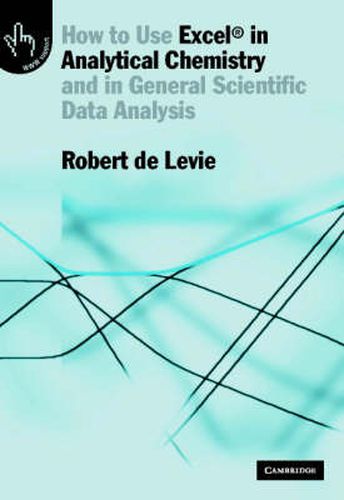
Because of their intuitive layout, extensive mathematical capabilities, and convenient graphics, spreadsheets provide an easy, straightforward route to scientific computing. This textbook for undergraduate and entry-level graduate chemistry and chemical engineering students uses Excel, the most powerful available spreadsheet, to explore and solve problems in general and chemical data analysis. This is the only up-to-date text on the use of spreadsheets in chemistry. The book discusses topics including statistics, chemical equilibria, pH calculations, titrations, and instrumental methods such as chromatography, spectrometry, and electroanalysis. It contains many examples of data analysis, and uses spreadsheets for numerical simulations, and testing analytical procedures. It also treats modern data analysis methods such as linear and non-linear least squares in great detail, as well as methods based on Fourier transformation. The book shows how matrix methods can be powerful tools in data analysis, and how easily these are implemented on a spreadsheet and describes in detail how to simulate chemical kinetics on a spreadsheet. It also introduces the reader to the use of VBA, the macro language of Microsoft Office, which lets the user import higher-level computer programs into the spreadsheet.
$9.00 standard shipping within Australia
FREE standard shipping within Australia for orders over $100.00
Express & International shipping calculated at checkout
Stock availability can be subject to change without notice. We recommend calling the shop or contacting our online team to check availability of low stock items. Please see our Shopping Online page for more details.
Because of their intuitive layout, extensive mathematical capabilities, and convenient graphics, spreadsheets provide an easy, straightforward route to scientific computing. This textbook for undergraduate and entry-level graduate chemistry and chemical engineering students uses Excel, the most powerful available spreadsheet, to explore and solve problems in general and chemical data analysis. This is the only up-to-date text on the use of spreadsheets in chemistry. The book discusses topics including statistics, chemical equilibria, pH calculations, titrations, and instrumental methods such as chromatography, spectrometry, and electroanalysis. It contains many examples of data analysis, and uses spreadsheets for numerical simulations, and testing analytical procedures. It also treats modern data analysis methods such as linear and non-linear least squares in great detail, as well as methods based on Fourier transformation. The book shows how matrix methods can be powerful tools in data analysis, and how easily these are implemented on a spreadsheet and describes in detail how to simulate chemical kinetics on a spreadsheet. It also introduces the reader to the use of VBA, the macro language of Microsoft Office, which lets the user import higher-level computer programs into the spreadsheet.
Search our extensive online catalogue.
