Readings Newsletter
Become a Readings Member to make your shopping experience even easier.
Sign in or sign up for free!
You’re not far away from qualifying for FREE standard shipping within Australia
You’ve qualified for FREE standard shipping within Australia
The cart is loading…


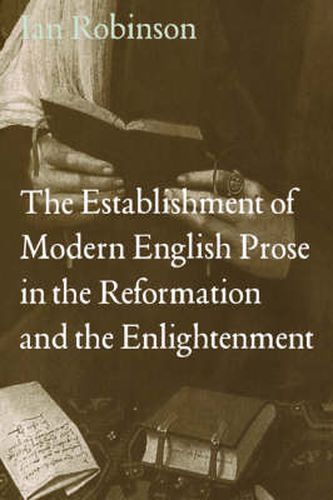
In The Establishment of Modern English Prose in the Reformation and the Enlightenment Ian Robinson traces the legacy of prose writing as an art form that was theorised and propagated in a manner quite distinct from verse. Robinson argues that the history of English prose has been misrepresented by critics who have failed to understand the grammatical complexities of the language. Engaging with histories of rhetoric as well as the work of the great prose writers in English, Robinson provides a bold reappraisal of this literary form, combining literary criticism with linguistic and textual analysis. He shows that the formal construct of the sentence itself is historically conditioned and no older than the post-medieval world. The relationship between rhetorical style and literary meaning, Robinson argues, is at the heart of the way we understand the external world.
$9.00 standard shipping within Australia
FREE standard shipping within Australia for orders over $100.00
Express & International shipping calculated at checkout
Stock availability can be subject to change without notice. We recommend calling the shop or contacting our online team to check availability of low stock items. Please see our Shopping Online page for more details.
In The Establishment of Modern English Prose in the Reformation and the Enlightenment Ian Robinson traces the legacy of prose writing as an art form that was theorised and propagated in a manner quite distinct from verse. Robinson argues that the history of English prose has been misrepresented by critics who have failed to understand the grammatical complexities of the language. Engaging with histories of rhetoric as well as the work of the great prose writers in English, Robinson provides a bold reappraisal of this literary form, combining literary criticism with linguistic and textual analysis. He shows that the formal construct of the sentence itself is historically conditioned and no older than the post-medieval world. The relationship between rhetorical style and literary meaning, Robinson argues, is at the heart of the way we understand the external world.
Search our extensive online catalogue.
