Readings Newsletter
Become a Readings Member to make your shopping experience even easier.
Sign in or sign up for free!
You’re not far away from qualifying for FREE standard shipping within Australia
You’ve qualified for FREE standard shipping within Australia
The cart is loading…


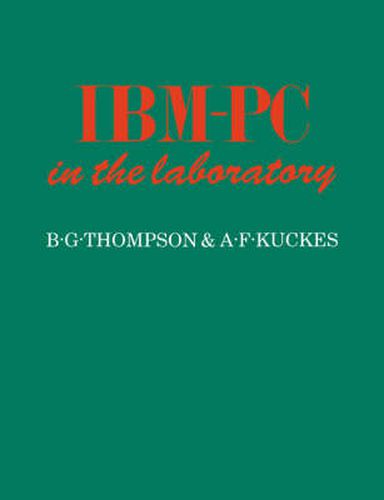
This book is about how microcomputers can be used to help control and interface with sensors in laboratory experiments. The computer work is done mostly in the context of several physics experiments, such as the physics of activation temperature, heat diffusion, and motion in fluids. These experiments show how with computer control conceptually sophisticated experiments can be performed with simple apparati. The authors explain how the computer interfaces with common sensing devices, including digital-to-analog coverter, analog-to-digital converter, timers, digital input and output devices, optical encoders, stepping motors, and analog amplifiers, to provide a link between the experimenter and the physical phenomena being studied. The authors chose the IBM-PC, AT, or XT (which can apply to clones as long as they have expansion slots to accomodate boards) as their example, and use Turbo Pascal (Version 4.0 or greater) throughout the book for programming. Most of the programs will be presented by way of example, so some experience in computer programming is necessary. The equivalent of two semesters of college physics is also helpful to understand the experiments.
$9.00 standard shipping within Australia
FREE standard shipping within Australia for orders over $100.00
Express & International shipping calculated at checkout
Stock availability can be subject to change without notice. We recommend calling the shop or contacting our online team to check availability of low stock items. Please see our Shopping Online page for more details.
This book is about how microcomputers can be used to help control and interface with sensors in laboratory experiments. The computer work is done mostly in the context of several physics experiments, such as the physics of activation temperature, heat diffusion, and motion in fluids. These experiments show how with computer control conceptually sophisticated experiments can be performed with simple apparati. The authors explain how the computer interfaces with common sensing devices, including digital-to-analog coverter, analog-to-digital converter, timers, digital input and output devices, optical encoders, stepping motors, and analog amplifiers, to provide a link between the experimenter and the physical phenomena being studied. The authors chose the IBM-PC, AT, or XT (which can apply to clones as long as they have expansion slots to accomodate boards) as their example, and use Turbo Pascal (Version 4.0 or greater) throughout the book for programming. Most of the programs will be presented by way of example, so some experience in computer programming is necessary. The equivalent of two semesters of college physics is also helpful to understand the experiments.
Search our extensive online catalogue.
