Readings Newsletter
Become a Readings Member to make your shopping experience even easier.
Sign in or sign up for free!
You’re not far away from qualifying for FREE standard shipping within Australia
You’ve qualified for FREE standard shipping within Australia
The cart is loading…


During animal development the descendants of a single cell form many different tissues and organs in appropriate positions within an embryo. To do this they must recognise their position, and this book examines our knowledge of how this is done. It starts by considering how much spatial pattern is already laid down when the egg forms inside the mother, and ends just before the formation of visible organs. Within these limits it considers evidence obtained by a variety of techniques, both experimental and biochemical, and from the embryos of many different animal groups. This breadth of coverage and the amount of detail afforded, particularly to the experimental studies, distinguish it from competing works and will make it a very valuable review. Moreover, in the final chapter the author analyses this evidence in ways which will be new to most readers, and which call into question current ideas about spatial determination.
$9.00 standard shipping within Australia
FREE standard shipping within Australia for orders over $100.00
Express & International shipping calculated at checkout
Stock availability can be subject to change without notice. We recommend calling the shop or contacting our online team to check availability of low stock items. Please see our Shopping Online page for more details.
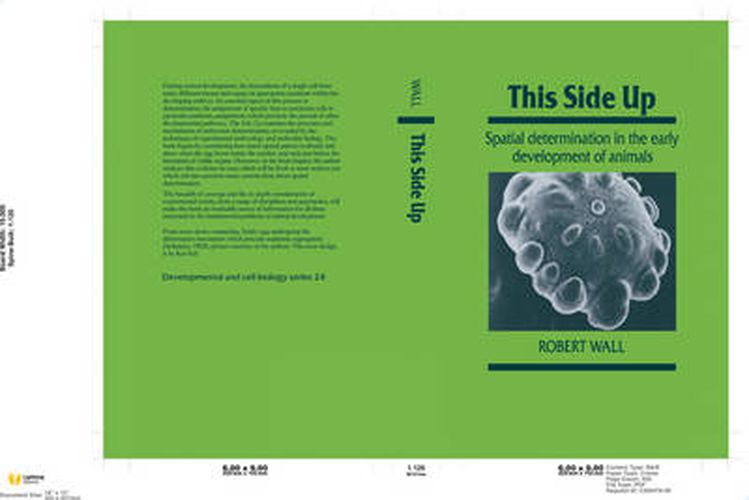
During animal development the descendants of a single cell form many different tissues and organs in appropriate positions within an embryo. To do this they must recognise their position, and this book examines our knowledge of how this is done. It starts by considering how much spatial pattern is already laid down when the egg forms inside the mother, and ends just before the formation of visible organs. Within these limits it considers evidence obtained by a variety of techniques, both experimental and biochemical, and from the embryos of many different animal groups. This breadth of coverage and the amount of detail afforded, particularly to the experimental studies, distinguish it from competing works and will make it a very valuable review. Moreover, in the final chapter the author analyses this evidence in ways which will be new to most readers, and which call into question current ideas about spatial determination.
Search our extensive online catalogue.
