Readings Newsletter
Become a Readings Member to make your shopping experience even easier.
Sign in or sign up for free!
You’re not far away from qualifying for FREE standard shipping within Australia
You’ve qualified for FREE standard shipping within Australia
The cart is loading…


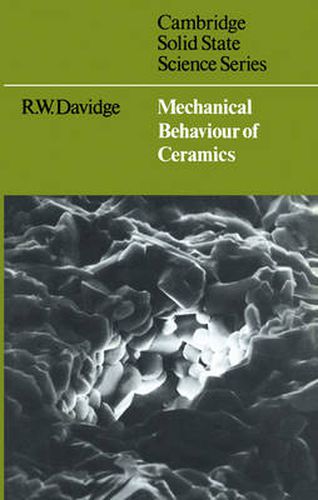
Although the basis for understanding the brittle fracture strength of ceramics was established by A. A. Griffith in 1920, much of our detailed knowledge was developed during the 1970s. This book was first published in 1979, when the science of the mechanical behaviour of engineering ceramics had reached a consolidated stage and was being applied ever increasingly to engineering situations. The bulk of the information was still scattered in scientific journals and this volume sought to consolidate these. This book presents the scientific foundations of mechanical behaviour and demonstrates how these can be used in engineering situations. The emphasis is on principles, illustrated by a careful selection of experimental data. This book will continue to have value as a reference work on this exciting subject.
$9.00 standard shipping within Australia
FREE standard shipping within Australia for orders over $100.00
Express & International shipping calculated at checkout
Stock availability can be subject to change without notice. We recommend calling the shop or contacting our online team to check availability of low stock items. Please see our Shopping Online page for more details.
Although the basis for understanding the brittle fracture strength of ceramics was established by A. A. Griffith in 1920, much of our detailed knowledge was developed during the 1970s. This book was first published in 1979, when the science of the mechanical behaviour of engineering ceramics had reached a consolidated stage and was being applied ever increasingly to engineering situations. The bulk of the information was still scattered in scientific journals and this volume sought to consolidate these. This book presents the scientific foundations of mechanical behaviour and demonstrates how these can be used in engineering situations. The emphasis is on principles, illustrated by a careful selection of experimental data. This book will continue to have value as a reference work on this exciting subject.
Search our extensive online catalogue.
