Readings Newsletter
Become a Readings Member to make your shopping experience even easier.
Sign in or sign up for free!
You’re not far away from qualifying for FREE standard shipping within Australia
You’ve qualified for FREE standard shipping within Australia
The cart is loading…


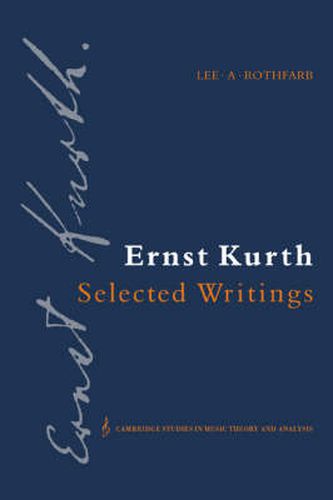
This book provides a selection of annotated translations from Ernst Kurth’s three best-known publications: Grundlagen des linearen Kontrapunkts (1917), Romantische Harmonik und ihre Krise in Wagners ‘Tristan’ (1920), and Bruckner (1925). Kurth’s contemporaries considered these books to be pioneering studies in the music of J. S. Bach, Wagner and Bruckner. Professor Rothfarb’s extensive introductory essay discusses the intellectual and socio-cultural environment in which Kurth was writing, referring to aspects of the early twentieth-century cultural renewal movements and to intellectual developments of the day in phenomenology, aesthetics and psychology. By reading Kurth against the cultural-intellectual background provided in the essay and commentaries, today’s music historians and theorists can round out their picture of music theory in the early twentieth century.
$9.00 standard shipping within Australia
FREE standard shipping within Australia for orders over $100.00
Express & International shipping calculated at checkout
Stock availability can be subject to change without notice. We recommend calling the shop or contacting our online team to check availability of low stock items. Please see our Shopping Online page for more details.
This book provides a selection of annotated translations from Ernst Kurth’s three best-known publications: Grundlagen des linearen Kontrapunkts (1917), Romantische Harmonik und ihre Krise in Wagners ‘Tristan’ (1920), and Bruckner (1925). Kurth’s contemporaries considered these books to be pioneering studies in the music of J. S. Bach, Wagner and Bruckner. Professor Rothfarb’s extensive introductory essay discusses the intellectual and socio-cultural environment in which Kurth was writing, referring to aspects of the early twentieth-century cultural renewal movements and to intellectual developments of the day in phenomenology, aesthetics and psychology. By reading Kurth against the cultural-intellectual background provided in the essay and commentaries, today’s music historians and theorists can round out their picture of music theory in the early twentieth century.
Search our extensive online catalogue.
