Readings Newsletter
Become a Readings Member to make your shopping experience even easier.
Sign in or sign up for free!
You’re not far away from qualifying for FREE standard shipping within Australia
You’ve qualified for FREE standard shipping within Australia
The cart is loading…


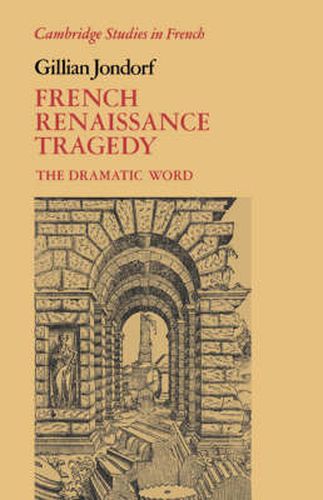
The principle aim of this 1990 book is to encourage readers to find pleasure in sixteenth-century tragedies. To this end, Gillian Jondorf examines a range of plays (all accessible in modern editions) in two ways. She suggests, by means of comparisons with other works, that techniques such as allusiveness need be no more forbidding in humanist tragedy than in, say, Racine or Lamartine. She shows how other features, such as characterization, structure, and the use of Choruses, become not only comprehensible but satisfying when the guiding theme or idee maitresse of a play has been identified and its organizing principles understood. Dr Jondorf argues that these plays should be seen not as pardonably clumsy experiments by the first practitioners of a genre, but as competent works which display skilful deployment of technique in the service of dramatic aims which are, in the broadest sense, didactic. French Renaissance tragedy has too often been treated, even by its defenders, merely as a staging post on the road that leads to Corneille and Racine. This book corrects that perspective.
$9.00 standard shipping within Australia
FREE standard shipping within Australia for orders over $100.00
Express & International shipping calculated at checkout
Stock availability can be subject to change without notice. We recommend calling the shop or contacting our online team to check availability of low stock items. Please see our Shopping Online page for more details.
The principle aim of this 1990 book is to encourage readers to find pleasure in sixteenth-century tragedies. To this end, Gillian Jondorf examines a range of plays (all accessible in modern editions) in two ways. She suggests, by means of comparisons with other works, that techniques such as allusiveness need be no more forbidding in humanist tragedy than in, say, Racine or Lamartine. She shows how other features, such as characterization, structure, and the use of Choruses, become not only comprehensible but satisfying when the guiding theme or idee maitresse of a play has been identified and its organizing principles understood. Dr Jondorf argues that these plays should be seen not as pardonably clumsy experiments by the first practitioners of a genre, but as competent works which display skilful deployment of technique in the service of dramatic aims which are, in the broadest sense, didactic. French Renaissance tragedy has too often been treated, even by its defenders, merely as a staging post on the road that leads to Corneille and Racine. This book corrects that perspective.
Search our extensive online catalogue.
