Readings Newsletter
Become a Readings Member to make your shopping experience even easier.
Sign in or sign up for free!
You’re not far away from qualifying for FREE standard shipping within Australia
You’ve qualified for FREE standard shipping within Australia
The cart is loading…


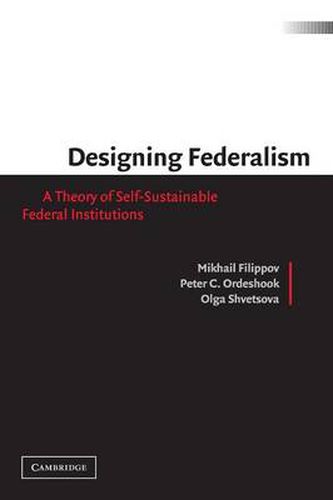
Because of the redistributive nature of institutions and the availability of implementable alternatives with different distributive consequences, the desire of federation members to change institutional specifics in their favor is a permanent feature of the federal political process. This is so for two reasons. First, states or their equivalents in democratic federations usually can succeed in renegotiating the rules if they feel sufficiently motivated to do so. Second, in the case of a federation it is more or less clear who stands to benefit from any change in institutions. Thus, the existence of an equilibrium of constitutional legitimacy at the popular and elite levels cannot be taken for granted. The authors show that the presence in the political process of agents who are ‘naturally committed’ to the status-quo institutional arrangement can suffice to coordinate voters to act as if they support existing constitutional arrangements.
$9.00 standard shipping within Australia
FREE standard shipping within Australia for orders over $100.00
Express & International shipping calculated at checkout
Stock availability can be subject to change without notice. We recommend calling the shop or contacting our online team to check availability of low stock items. Please see our Shopping Online page for more details.
Because of the redistributive nature of institutions and the availability of implementable alternatives with different distributive consequences, the desire of federation members to change institutional specifics in their favor is a permanent feature of the federal political process. This is so for two reasons. First, states or their equivalents in democratic federations usually can succeed in renegotiating the rules if they feel sufficiently motivated to do so. Second, in the case of a federation it is more or less clear who stands to benefit from any change in institutions. Thus, the existence of an equilibrium of constitutional legitimacy at the popular and elite levels cannot be taken for granted. The authors show that the presence in the political process of agents who are ‘naturally committed’ to the status-quo institutional arrangement can suffice to coordinate voters to act as if they support existing constitutional arrangements.
Search our extensive online catalogue.
