Readings Newsletter
Become a Readings Member to make your shopping experience even easier.
Sign in or sign up for free!
You’re not far away from qualifying for FREE standard shipping within Australia
You’ve qualified for FREE standard shipping within Australia
The cart is loading…


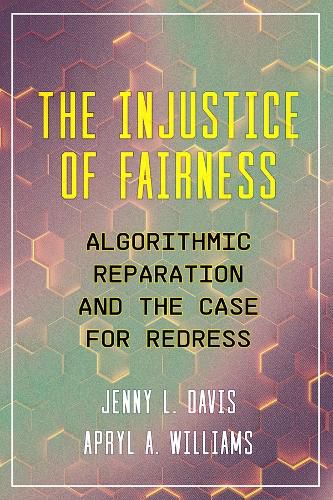
The Injustice of Fairness shifts the foundation of algorithmic ethics, displacing "fairness" with repair and redress. A substantial and growing field, algorithmic ethics aims to mitigate harms and realize social good. The fairness paradigm dominates this field across AI, machine learning, and other data-driven domains. So far, efforts toward fairness have been unsuccessful, with algorithmic harms that propagate and persist. Davis and Williams explain why algorithmic fairness perpetually fails and present "algorithmic reparation" in its place.
The stakes are high because algorithms are everywhere-from law to love, healthcare to housing, education to media, and beyond. More than lines of code or mathematical operations, algorithms carry history, configure the present, and are actively shaping the future. Set against a backdrop of societal instability and technological transformation, The Injustice of Fairness offers a careful critique, original framework, and blueprint for social change with algorithms as entry points and levers.
$9.00 standard shipping within Australia
FREE standard shipping within Australia for orders over $100.00
Express & International shipping calculated at checkout
Stock availability can be subject to change without notice. We recommend calling the shop or contacting our online team to check availability of low stock items. Please see our Shopping Online page for more details.
The Injustice of Fairness shifts the foundation of algorithmic ethics, displacing "fairness" with repair and redress. A substantial and growing field, algorithmic ethics aims to mitigate harms and realize social good. The fairness paradigm dominates this field across AI, machine learning, and other data-driven domains. So far, efforts toward fairness have been unsuccessful, with algorithmic harms that propagate and persist. Davis and Williams explain why algorithmic fairness perpetually fails and present "algorithmic reparation" in its place.
The stakes are high because algorithms are everywhere-from law to love, healthcare to housing, education to media, and beyond. More than lines of code or mathematical operations, algorithms carry history, configure the present, and are actively shaping the future. Set against a backdrop of societal instability and technological transformation, The Injustice of Fairness offers a careful critique, original framework, and blueprint for social change with algorithms as entry points and levers.
Search our extensive online catalogue.
