Readings Newsletter
Become a Readings Member to make your shopping experience even easier.
Sign in or sign up for free!
You’re not far away from qualifying for FREE standard shipping within Australia
You’ve qualified for FREE standard shipping within Australia
The cart is loading…


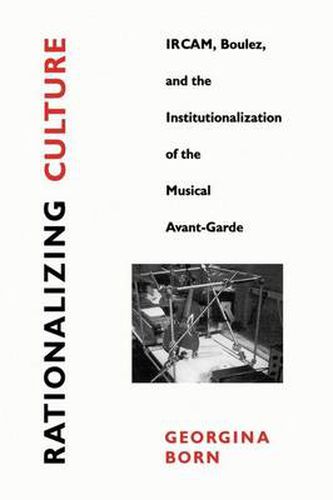
Anthropologist Georgina Born presents one of the first ethnographies of a powerful western cultural organization, the renowned Institut de Recherche et de Coordination Acoustique/Musique (IRCAM) in Paris. As a year-long participant-observer, Born studied the social and cultural economy of an institution for research and production of avant-garde and computer music. She gives a unique portrait of IRCAM’s composers, computer scientists, technicians, and secretaries, interrogating the effects of the cultural philosophy of the controversial avant-garde composer, Pierre Boulez, who directed the institute until 1992.
Born depicts a major artistic institution trying to maintain its status and legitimacy in an era increasingly dominated by market forces, and in a volatile political and cultural climate. She illuminates the erosion of the legitimacy of art and science in the face of growing commercial and political pressures. By tracing how IRCAM has tried to accomodate these pressures while preserving its autonomy, Born reveals the contradictory effects of institutionalizing an avant-garde.
Contrary to those who see postmodernism representing an accord between high and popular culture, Born stresses the continuities between modernism and postmodernism and how postmodernism itself embodies an implicit antagonism toward popular culture.
$9.00 standard shipping within Australia
FREE standard shipping within Australia for orders over $100.00
Express & International shipping calculated at checkout
Stock availability can be subject to change without notice. We recommend calling the shop or contacting our online team to check availability of low stock items. Please see our Shopping Online page for more details.
Anthropologist Georgina Born presents one of the first ethnographies of a powerful western cultural organization, the renowned Institut de Recherche et de Coordination Acoustique/Musique (IRCAM) in Paris. As a year-long participant-observer, Born studied the social and cultural economy of an institution for research and production of avant-garde and computer music. She gives a unique portrait of IRCAM’s composers, computer scientists, technicians, and secretaries, interrogating the effects of the cultural philosophy of the controversial avant-garde composer, Pierre Boulez, who directed the institute until 1992.
Born depicts a major artistic institution trying to maintain its status and legitimacy in an era increasingly dominated by market forces, and in a volatile political and cultural climate. She illuminates the erosion of the legitimacy of art and science in the face of growing commercial and political pressures. By tracing how IRCAM has tried to accomodate these pressures while preserving its autonomy, Born reveals the contradictory effects of institutionalizing an avant-garde.
Contrary to those who see postmodernism representing an accord between high and popular culture, Born stresses the continuities between modernism and postmodernism and how postmodernism itself embodies an implicit antagonism toward popular culture.
Search our extensive online catalogue.
