Readings Newsletter
Become a Readings Member to make your shopping experience even easier.
Sign in or sign up for free!
You’re not far away from qualifying for FREE standard shipping within Australia
You’ve qualified for FREE standard shipping within Australia
The cart is loading…


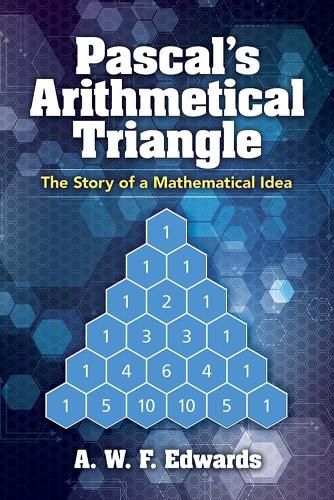
An impressive culmination of meticulous research into original sources, this definitive study constitutes the first full-length history of the Arithmetic Triangle. - Mathematics of Computation Pascal’s Arithmetical Triangle was named for the seventeenth-century French philosopher/mathematician Blaise Pascal, though he did not invent it. A never-ending equilateral triangle of numbers that follow the rule of adding the two numbers above to get the number below, it appears much earlier in the literature of Hindu and Arabic mathematics and continues to fascinate Western mathematicians. Two sides are comprised of all 1s and because the triangle is infinite, there is no bottom side. This book by A. W. F. Edwards, Professor of Biometry at the University of Cambridge, explores Pascal’s Arithmetical Triangle and the way it has been studied, enjoyed, and used by mathematicians throughout history.
A fascinating book…giving new insights into the early history of probability theory and combinatorics and incidentally providing much stimulating material for teachers of mathematics. - G. A. Bernard, International Statistical Institute Review
Scrupulously researched … carries the reader along in a rewarding manner. It is a scientific who-dun-it and one must admire the author for the scholarly yet unpedantic manner in which he disperses some of the mists of antiquity. - A. W. Kemp, Biometrics
Recommended not only to historians and mathematicians, but also to students seeking to put some life into the dry treatment of these topics to which they have doubtless been subjected. - Ivor Grattan-Guinness, Annals of Science AUTHOR: A. E. W. Edwards is Emeritus Professor of Biometry at the University of Cambridge and a Fellow of Gonville and Caius College, Cambridge.
$9.00 standard shipping within Australia
FREE standard shipping within Australia for orders over $100.00
Express & International shipping calculated at checkout
Stock availability can be subject to change without notice. We recommend calling the shop or contacting our online team to check availability of low stock items. Please see our Shopping Online page for more details.
An impressive culmination of meticulous research into original sources, this definitive study constitutes the first full-length history of the Arithmetic Triangle. - Mathematics of Computation Pascal’s Arithmetical Triangle was named for the seventeenth-century French philosopher/mathematician Blaise Pascal, though he did not invent it. A never-ending equilateral triangle of numbers that follow the rule of adding the two numbers above to get the number below, it appears much earlier in the literature of Hindu and Arabic mathematics and continues to fascinate Western mathematicians. Two sides are comprised of all 1s and because the triangle is infinite, there is no bottom side. This book by A. W. F. Edwards, Professor of Biometry at the University of Cambridge, explores Pascal’s Arithmetical Triangle and the way it has been studied, enjoyed, and used by mathematicians throughout history.
A fascinating book…giving new insights into the early history of probability theory and combinatorics and incidentally providing much stimulating material for teachers of mathematics. - G. A. Bernard, International Statistical Institute Review
Scrupulously researched … carries the reader along in a rewarding manner. It is a scientific who-dun-it and one must admire the author for the scholarly yet unpedantic manner in which he disperses some of the mists of antiquity. - A. W. Kemp, Biometrics
Recommended not only to historians and mathematicians, but also to students seeking to put some life into the dry treatment of these topics to which they have doubtless been subjected. - Ivor Grattan-Guinness, Annals of Science AUTHOR: A. E. W. Edwards is Emeritus Professor of Biometry at the University of Cambridge and a Fellow of Gonville and Caius College, Cambridge.
Search our extensive online catalogue.
