Readings Newsletter
Become a Readings Member to make your shopping experience even easier.
Sign in or sign up for free!
You’re not far away from qualifying for FREE standard shipping within Australia
You’ve qualified for FREE standard shipping within Australia
The cart is loading…


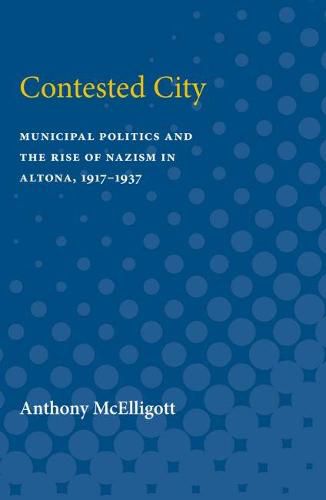
In the wake of the First World War, many Germans saw the future of their nation as contingent on a vision of municipal progress. In this well-researched study, Anthony McElligott uses local politics as an analytical tool to decipher the bigger picture of the fate of the Weimar Republic. Focusing on the industrial city of Altona, McElligott locates his discussion of the contradictions of the Weimar
local state
along two axes first, persistent financial, policy, and political conflict between the central and the local state; and, second, the conflicts within the Weimar local state between the displaced and resentful middle classes and the newly enfranchised working class. The Social Democrats used their considerable political influence at the local level to pursue progressive social policies. However, these local experiments in
practical socialism
alienated middle- and lower-middle-class voters without guaranteeing the support of all workers, since dwindling financial resources made it impossible to extend the benefits of the new social programs to many of the unskilled and poorer sections of the working class. Ultimately, the translation of the democratic republican vision into active policy provoked the conservative push for reassertion of central authority in the state. McElligott probes beneath the level of formal party conflicts to reconstruct the
politics of everyday life
at the street level. This study will be of wide interest to historians and political scientists.
$9.00 standard shipping within Australia
FREE standard shipping within Australia for orders over $100.00
Express & International shipping calculated at checkout
Stock availability can be subject to change without notice. We recommend calling the shop or contacting our online team to check availability of low stock items. Please see our Shopping Online page for more details.
In the wake of the First World War, many Germans saw the future of their nation as contingent on a vision of municipal progress. In this well-researched study, Anthony McElligott uses local politics as an analytical tool to decipher the bigger picture of the fate of the Weimar Republic. Focusing on the industrial city of Altona, McElligott locates his discussion of the contradictions of the Weimar
local state
along two axes first, persistent financial, policy, and political conflict between the central and the local state; and, second, the conflicts within the Weimar local state between the displaced and resentful middle classes and the newly enfranchised working class. The Social Democrats used their considerable political influence at the local level to pursue progressive social policies. However, these local experiments in
practical socialism
alienated middle- and lower-middle-class voters without guaranteeing the support of all workers, since dwindling financial resources made it impossible to extend the benefits of the new social programs to many of the unskilled and poorer sections of the working class. Ultimately, the translation of the democratic republican vision into active policy provoked the conservative push for reassertion of central authority in the state. McElligott probes beneath the level of formal party conflicts to reconstruct the
politics of everyday life
at the street level. This study will be of wide interest to historians and political scientists.
Search our extensive online catalogue.
