Readings Newsletter
Become a Readings Member to make your shopping experience even easier.
Sign in or sign up for free!
You’re not far away from qualifying for FREE standard shipping within Australia
You’ve qualified for FREE standard shipping within Australia
The cart is loading…


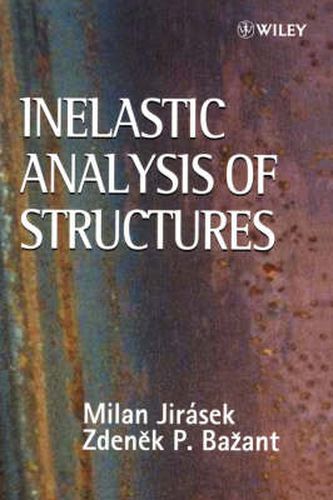
The modeling of mechanical properties of materials and structures is a complex and wide-ranging subject. In some applications, it is sufficient to assume that the material remains elastic, i.e. that the deformation process is fully reversible and the stress is a unique function of strain. However, such a simplified assumption is appropriate only within a limited range, and in general must be replaced by a more realistic approach that takes into account the inelastic processes such as plastic yielding or cracking. This book presents a comprehensive treatment of the most important areas of plasticity and of time-dependent inelastic behavior (viscoplasticity of metals, and creep and shrinkage of concrete). It covers structural aspects such as: incremental analysis limit analysis shakedown analysis optimal design beam structures subjected to bending and torsion yield line theory of plates slip line theory size effect in structures creep and shrinkage effects in concrete structures. The following aspects of the advanced material modeling are presented: yield surfaces for metals and plastic-frictional materials hardening and softening stress-return algorithms large-strain formulations thermodynamic framework microplane models localization of plastic strain. Inelastic Analysis of Structures is a textbook for basic and advanced courses on plasticity, with a slight emphasis on structural engineering applications, but with a wealth of material for geotechnical, mechanical, aerospace, naval, petroleum and nuclear engineers. The text is constructed in a very didactical way, while the mathematics has been kept rigorous.
$9.00 standard shipping within Australia
FREE standard shipping within Australia for orders over $100.00
Express & International shipping calculated at checkout
Stock availability can be subject to change without notice. We recommend calling the shop or contacting our online team to check availability of low stock items. Please see our Shopping Online page for more details.
The modeling of mechanical properties of materials and structures is a complex and wide-ranging subject. In some applications, it is sufficient to assume that the material remains elastic, i.e. that the deformation process is fully reversible and the stress is a unique function of strain. However, such a simplified assumption is appropriate only within a limited range, and in general must be replaced by a more realistic approach that takes into account the inelastic processes such as plastic yielding or cracking. This book presents a comprehensive treatment of the most important areas of plasticity and of time-dependent inelastic behavior (viscoplasticity of metals, and creep and shrinkage of concrete). It covers structural aspects such as: incremental analysis limit analysis shakedown analysis optimal design beam structures subjected to bending and torsion yield line theory of plates slip line theory size effect in structures creep and shrinkage effects in concrete structures. The following aspects of the advanced material modeling are presented: yield surfaces for metals and plastic-frictional materials hardening and softening stress-return algorithms large-strain formulations thermodynamic framework microplane models localization of plastic strain. Inelastic Analysis of Structures is a textbook for basic and advanced courses on plasticity, with a slight emphasis on structural engineering applications, but with a wealth of material for geotechnical, mechanical, aerospace, naval, petroleum and nuclear engineers. The text is constructed in a very didactical way, while the mathematics has been kept rigorous.
Search our extensive online catalogue.
