Readings Newsletter
Become a Readings Member to make your shopping experience even easier.
Sign in or sign up for free!
You’re not far away from qualifying for FREE standard shipping within Australia
You’ve qualified for FREE standard shipping within Australia
The cart is loading…


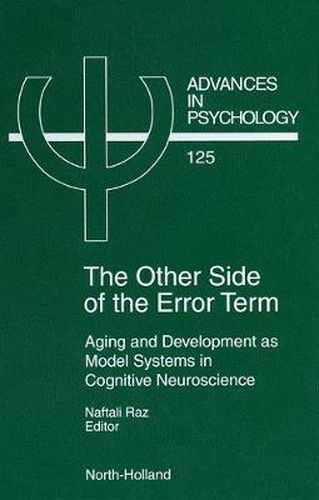
It has been said more than once in psychology that one person’s effect is another person’s error term. By minimising and occasionally ignoring individual and group variability cognitive psychology has yieled many fine achievements. However, when investigators are working with special populations, the subjects, and the unique nature of the sample, come into focus and become the goal in itself. For developmental psychologists, gerontologists and psychopathologists, research progresses with an eye on their target populations of study. Yet every good study in any of these domains inevitably has another dimension. Whenever a study is designed to turn a spotlight on a special population, the light is also shed on the mainstream from which the target deviates. This book examines what we can learn about general and universal phenomena in cognition and its brain substrates from examining the odd, the rare, the transient, the exceptional and the abnormal.
$9.00 standard shipping within Australia
FREE standard shipping within Australia for orders over $100.00
Express & International shipping calculated at checkout
Stock availability can be subject to change without notice. We recommend calling the shop or contacting our online team to check availability of low stock items. Please see our Shopping Online page for more details.
It has been said more than once in psychology that one person’s effect is another person’s error term. By minimising and occasionally ignoring individual and group variability cognitive psychology has yieled many fine achievements. However, when investigators are working with special populations, the subjects, and the unique nature of the sample, come into focus and become the goal in itself. For developmental psychologists, gerontologists and psychopathologists, research progresses with an eye on their target populations of study. Yet every good study in any of these domains inevitably has another dimension. Whenever a study is designed to turn a spotlight on a special population, the light is also shed on the mainstream from which the target deviates. This book examines what we can learn about general and universal phenomena in cognition and its brain substrates from examining the odd, the rare, the transient, the exceptional and the abnormal.
Search our extensive online catalogue.
