Readings Newsletter
Become a Readings Member to make your shopping experience even easier.
Sign in or sign up for free!
You’re not far away from qualifying for FREE standard shipping within Australia
You’ve qualified for FREE standard shipping within Australia
The cart is loading…


The primary objective of this volume, the first in a new series entitled Theoretical and Computational Chemistry, is to survey some effective approaches to understanding, describing and predicting ways in which solutes and solvents interact and the effects they have upon each other. The treatment of solute/solvent interactions that is presented emphasizes a synergism between theory and experiment. Data obtained experimentally are used as a basis for developing quantitative theoretical models that permit the correlation and interpretation of the data, and also provide a predictive capability. The latter being of course a key motivation for these efforts. Linear solvation energy relationships have been quite successful in this respect and accordingly receive considerable attention. Other effective approaches, including computational ones, are also being pursued, and are discussed in several chapters. This is an area that is continually evolving, and it is hoped that present volume will convey a sense of its dynamic nature.
$9.00 standard shipping within Australia
FREE standard shipping within Australia for orders over $100.00
Express & International shipping calculated at checkout
Stock availability can be subject to change without notice. We recommend calling the shop or contacting our online team to check availability of low stock items. Please see our Shopping Online page for more details.
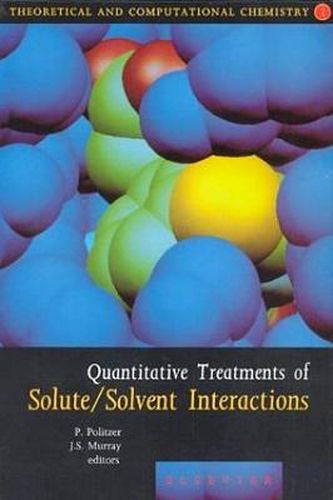
The primary objective of this volume, the first in a new series entitled Theoretical and Computational Chemistry, is to survey some effective approaches to understanding, describing and predicting ways in which solutes and solvents interact and the effects they have upon each other. The treatment of solute/solvent interactions that is presented emphasizes a synergism between theory and experiment. Data obtained experimentally are used as a basis for developing quantitative theoretical models that permit the correlation and interpretation of the data, and also provide a predictive capability. The latter being of course a key motivation for these efforts. Linear solvation energy relationships have been quite successful in this respect and accordingly receive considerable attention. Other effective approaches, including computational ones, are also being pursued, and are discussed in several chapters. This is an area that is continually evolving, and it is hoped that present volume will convey a sense of its dynamic nature.
Search our extensive online catalogue.
