Readings Newsletter
Become a Readings Member to make your shopping experience even easier.
Sign in or sign up for free!
You’re not far away from qualifying for FREE standard shipping within Australia
You’ve qualified for FREE standard shipping within Australia
The cart is loading…


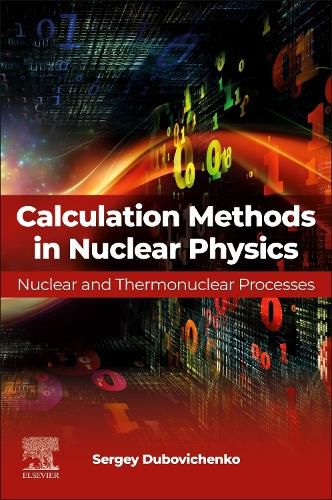
Calculation Methods in Nuclear Physics: Nuclear and Thermonuclear Processes is a specialized reference that addresses the critical need for advanced computational tools and mathematical models in nuclear physics research. It focuses on solving Schroedinger equations for various nuclear systems, including scattering states and bound states, using numerical and variational techniques. The book covers both real and complex potentials, with detailed algorithms and source code examples, primarily in Fortran 90 and Turbo Basic, enabling researchers and students to implement these methods in their own work. The chapters are organized systematically, covering topics such as scattering phase shifts, bound state characteristics, and cross-section analyses for nuclear scattering and photonuclear processes. The structure emphasizes practical, step-by-step procedures and computational algorithms, making it suitable for both theoretical development and implementation. The content systematically explores the Schroedinger equation, tensor potentials, phase shift analysis, and reaction cross sections, providing a comprehensive toolkit for nuclear reaction modeling. Calculation Methods in Nuclear Physics: Nuclear and Thermonuclear Processes is invaluable for nuclear physicists, computational scientists, and advanced students involved in low-energy nuclear reactions, structure analysis, and astrophysics. It bridges physical theory, mathematical methods, and programming, fostering a deeper understanding and practical skills essential for cutting-edge research. By offering detailed algorithms and models, the book enhances researchers' ability to perform precise nuclear data analysis and modeling, supporting ongoing advancements in nuclear science.
$9.00 standard shipping within Australia
FREE standard shipping within Australia for orders over $100.00
Express & International shipping calculated at checkout
Stock availability can be subject to change without notice. We recommend calling the shop or contacting our online team to check availability of low stock items. Please see our Shopping Online page for more details.
Calculation Methods in Nuclear Physics: Nuclear and Thermonuclear Processes is a specialized reference that addresses the critical need for advanced computational tools and mathematical models in nuclear physics research. It focuses on solving Schroedinger equations for various nuclear systems, including scattering states and bound states, using numerical and variational techniques. The book covers both real and complex potentials, with detailed algorithms and source code examples, primarily in Fortran 90 and Turbo Basic, enabling researchers and students to implement these methods in their own work. The chapters are organized systematically, covering topics such as scattering phase shifts, bound state characteristics, and cross-section analyses for nuclear scattering and photonuclear processes. The structure emphasizes practical, step-by-step procedures and computational algorithms, making it suitable for both theoretical development and implementation. The content systematically explores the Schroedinger equation, tensor potentials, phase shift analysis, and reaction cross sections, providing a comprehensive toolkit for nuclear reaction modeling. Calculation Methods in Nuclear Physics: Nuclear and Thermonuclear Processes is invaluable for nuclear physicists, computational scientists, and advanced students involved in low-energy nuclear reactions, structure analysis, and astrophysics. It bridges physical theory, mathematical methods, and programming, fostering a deeper understanding and practical skills essential for cutting-edge research. By offering detailed algorithms and models, the book enhances researchers' ability to perform precise nuclear data analysis and modeling, supporting ongoing advancements in nuclear science.
Search our extensive online catalogue.
