Readings Newsletter
Become a Readings Member to make your shopping experience even easier.
Sign in or sign up for free!
You’re not far away from qualifying for FREE standard shipping within Australia
You’ve qualified for FREE standard shipping within Australia
The cart is loading…


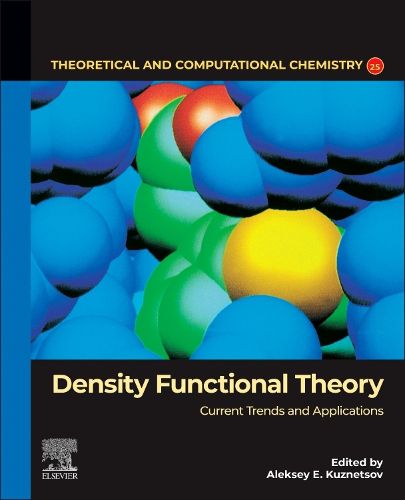
Density Functional Theory: Current Trends and Applications first examines the foundational knowledge surrounding DFT, examining some of its key concepts, such as the Thomas-Fermi model and the Hohenberg-Kohn-Sham theory; looking at the wealth of exchange-correlation functionals; and the advantages and disadvantages of DFT compared to the MO (molecular orbital ) theory and other methods, before exploring the areas of future DFT development. The second section then examines the practical methods and approaches for DFT, looking at the types of density functionals, such as LSDA (local spin-density approximation), GGA (generalized gradient approximation), and meta-GGA functionals; hybrid functionals; DFTB (density functional tight binding) methods; dispersion-corrected functionals; time-dependent DFT; and the plane-wave approach. It also looks at the relationships between DFT and ab initio molecular dynamics and the QM/MM (quantum mechanics/molecular mechanics) approach.
This book is designed for graduate- and postgraduate-level students and postdoctoral researchers principally studying computational and physical chemistry, who want to obtain an up-to-date overview and understanding of density functional and its applications.
$9.00 standard shipping within Australia
FREE standard shipping within Australia for orders over $100.00
Express & International shipping calculated at checkout
Stock availability can be subject to change without notice. We recommend calling the shop or contacting our online team to check availability of low stock items. Please see our Shopping Online page for more details.
Density Functional Theory: Current Trends and Applications first examines the foundational knowledge surrounding DFT, examining some of its key concepts, such as the Thomas-Fermi model and the Hohenberg-Kohn-Sham theory; looking at the wealth of exchange-correlation functionals; and the advantages and disadvantages of DFT compared to the MO (molecular orbital ) theory and other methods, before exploring the areas of future DFT development. The second section then examines the practical methods and approaches for DFT, looking at the types of density functionals, such as LSDA (local spin-density approximation), GGA (generalized gradient approximation), and meta-GGA functionals; hybrid functionals; DFTB (density functional tight binding) methods; dispersion-corrected functionals; time-dependent DFT; and the plane-wave approach. It also looks at the relationships between DFT and ab initio molecular dynamics and the QM/MM (quantum mechanics/molecular mechanics) approach.
This book is designed for graduate- and postgraduate-level students and postdoctoral researchers principally studying computational and physical chemistry, who want to obtain an up-to-date overview and understanding of density functional and its applications.
Search our extensive online catalogue.
