Readings Newsletter
Become a Readings Member to make your shopping experience even easier.
Sign in or sign up for free!
You’re not far away from qualifying for FREE standard shipping within Australia
You’ve qualified for FREE standard shipping within Australia
The cart is loading…


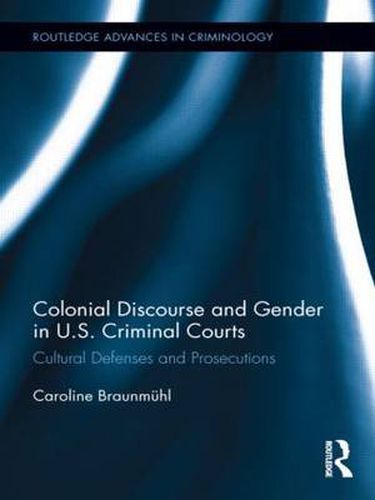
The occurrence in some criminal cases of cultural defenses on behalf of minority defendants has stirred much debate. This book is the first to illuminate how cultural evidence – i.e., evidence regarding ethnicity – is actually negotiated by attorneys, expert/lay witnesses, and defendants in criminal trials. Caroline Braunmuhl demonstrates that this has occurred, overwhelmingly, in ways shaped by colonialist and patriarchal discourses common in the Western world. She argues that the controversy regarding the legitimacy of a cultural defense has tended to obscure this fact, and has been biased against minorities as well as all women from its inception, in the very terms in which the question for debate has been framed. This study also breaks new ground by analyzing the strategies, and the failures, in which colonialist and patriarchal constructions of cultural evidence are resisted or – more commonly – colluded in by opposing attorneys, witnesses, and defendants themselves. The constructions at hand emerge as contradictory and unstable, belying the notion that cultural evidence is a matter of objective information about another culture, rather than – as Braunmuhl argues – of discourses that are inevitably normatively charged. Colonial Discourse and Gender in US Criminal Courts moves the debate about cultural defenses onto an entirely new plane, one based upon the understanding that only in-depth empirical analyses informed by critical, rigorous theoretical reflection can do justice to the irreducibly political character of any discussion of cultural evidence, and of its presentation in court.
$9.00 standard shipping within Australia
FREE standard shipping within Australia for orders over $100.00
Express & International shipping calculated at checkout
Stock availability can be subject to change without notice. We recommend calling the shop or contacting our online team to check availability of low stock items. Please see our Shopping Online page for more details.
The occurrence in some criminal cases of cultural defenses on behalf of minority defendants has stirred much debate. This book is the first to illuminate how cultural evidence – i.e., evidence regarding ethnicity – is actually negotiated by attorneys, expert/lay witnesses, and defendants in criminal trials. Caroline Braunmuhl demonstrates that this has occurred, overwhelmingly, in ways shaped by colonialist and patriarchal discourses common in the Western world. She argues that the controversy regarding the legitimacy of a cultural defense has tended to obscure this fact, and has been biased against minorities as well as all women from its inception, in the very terms in which the question for debate has been framed. This study also breaks new ground by analyzing the strategies, and the failures, in which colonialist and patriarchal constructions of cultural evidence are resisted or – more commonly – colluded in by opposing attorneys, witnesses, and defendants themselves. The constructions at hand emerge as contradictory and unstable, belying the notion that cultural evidence is a matter of objective information about another culture, rather than – as Braunmuhl argues – of discourses that are inevitably normatively charged. Colonial Discourse and Gender in US Criminal Courts moves the debate about cultural defenses onto an entirely new plane, one based upon the understanding that only in-depth empirical analyses informed by critical, rigorous theoretical reflection can do justice to the irreducibly political character of any discussion of cultural evidence, and of its presentation in court.
Search our extensive online catalogue.
