Readings Newsletter
Become a Readings Member to make your shopping experience even easier.
Sign in or sign up for free!
You’re not far away from qualifying for FREE standard shipping within Australia
You’ve qualified for FREE standard shipping within Australia
The cart is loading…


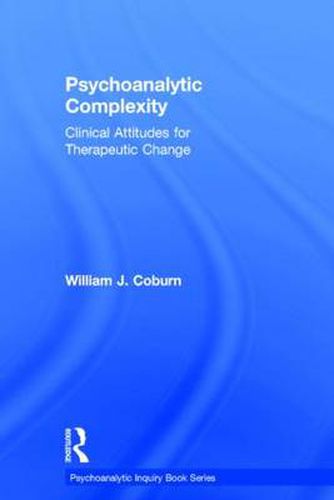
Psychoanalytic Complexity is the application of a multidisciplinary, explanatory theory to clinical psychoanalysis and psychotherapy. It carries with it incisive and pivotal attitudes that aim to transform our understanding of therapeutic action and the change process. Here, William Coburn offers a revolutionary and far-reaching counterpoint to the remnants of Cartesianism and scientism, respecting and encouraging human anomaly rather than pathologizing or obliterating the uniqueness of the individual person.
In Psychoanaltyic Complexity, William Coburn explores the value of complexity theory previously understood as an explanatory framework with which clinicians can better understand, retrospectively, therapeutic action and the change process. He further extends this sensibility by examining the ways in which such a rich theoretical framework can inform what clinicians can do, prospectively, to effect positive change within the therapeutic relationship. He persuasively argues that the medium of bringing to light new ways of relating, emotional experiencing, and meaning making resides in the fundamental attitudes derived from a complexity theory sensibility as applied to psychoanalysis and psychotherapy.
Using a variety of clinical illustrations throughout, Psychoanalytic Complexity is a radical corrective to reductionism and the more traditional presumption that the problem lies with the patient and the cure lies with the therapist. It offers a new language, vocabulary, way of thinking, and a new way of being with others that are pivotal in arriving at affirmative therapeutic change. This book is intended for psychoanalysts, clinical psychologists, therapists, mental health counsellors, academics and teachers who are interested in new trends in psychoanalysis and psychotherapy.
$9.00 standard shipping within Australia
FREE standard shipping within Australia for orders over $100.00
Express & International shipping calculated at checkout
Stock availability can be subject to change without notice. We recommend calling the shop or contacting our online team to check availability of low stock items. Please see our Shopping Online page for more details.
Psychoanalytic Complexity is the application of a multidisciplinary, explanatory theory to clinical psychoanalysis and psychotherapy. It carries with it incisive and pivotal attitudes that aim to transform our understanding of therapeutic action and the change process. Here, William Coburn offers a revolutionary and far-reaching counterpoint to the remnants of Cartesianism and scientism, respecting and encouraging human anomaly rather than pathologizing or obliterating the uniqueness of the individual person.
In Psychoanaltyic Complexity, William Coburn explores the value of complexity theory previously understood as an explanatory framework with which clinicians can better understand, retrospectively, therapeutic action and the change process. He further extends this sensibility by examining the ways in which such a rich theoretical framework can inform what clinicians can do, prospectively, to effect positive change within the therapeutic relationship. He persuasively argues that the medium of bringing to light new ways of relating, emotional experiencing, and meaning making resides in the fundamental attitudes derived from a complexity theory sensibility as applied to psychoanalysis and psychotherapy.
Using a variety of clinical illustrations throughout, Psychoanalytic Complexity is a radical corrective to reductionism and the more traditional presumption that the problem lies with the patient and the cure lies with the therapist. It offers a new language, vocabulary, way of thinking, and a new way of being with others that are pivotal in arriving at affirmative therapeutic change. This book is intended for psychoanalysts, clinical psychologists, therapists, mental health counsellors, academics and teachers who are interested in new trends in psychoanalysis and psychotherapy.
Search our extensive online catalogue.
