Readings Newsletter
Become a Readings Member to make your shopping experience even easier.
Sign in or sign up for free!
You’re not far away from qualifying for FREE standard shipping within Australia
You’ve qualified for FREE standard shipping within Australia
The cart is loading…


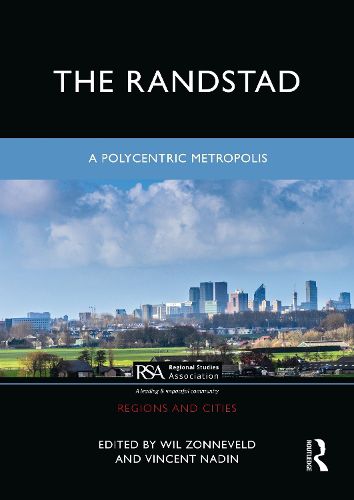
The Randstad metropolitan region encompassing Amsterdam, The Hague, Rotterdam and Utrecht in the western Netherlands is regarded worldwide as a model of a ‘successful’ polycentric metropolis. It is widely cited as an example of how a region of interconnected small cities can effectively compete globally by providing complementary functions which together match the power of large monocentric cities. The methods of strategic spatial planning, regional design and strategic projects that are said to underpin this polycentric metropolis are used as models for practitioners and students around the world.
But is this high reputation deserved? Does the Randstad really function as a polycentric metropolis? The operation of the Randstad as a polycentric networked region is controversial both in terms of the actual strength of relations between its component parts, and the value of promoting polycentricity in policy. What are the costs and benefits of a Randstad metropolis? Does polycentricity improve the performance of the region in economic, social and environmental terms? How has the polycentric metropolis evolved and what part is played by its delta location? Has spatial planning made a difference in the form and operation of the region today? How will this spatial configuration fare in the face of the climate crisis and need to create healthy cities and regions? Is there benefit in pursuing the idea of a polycentric metropolis in government policy and action, and how?
These questions are of critical interest within the Netherlands but experience in the Randstad offers valuable insights to many other complex urban regions around the world. This book will provide a critical analysis of the Randstad and lessons for strategic planning in other metropolitan regions.
$9.00 standard shipping within Australia
FREE standard shipping within Australia for orders over $100.00
Express & International shipping calculated at checkout
Stock availability can be subject to change without notice. We recommend calling the shop or contacting our online team to check availability of low stock items. Please see our Shopping Online page for more details.
The Randstad metropolitan region encompassing Amsterdam, The Hague, Rotterdam and Utrecht in the western Netherlands is regarded worldwide as a model of a ‘successful’ polycentric metropolis. It is widely cited as an example of how a region of interconnected small cities can effectively compete globally by providing complementary functions which together match the power of large monocentric cities. The methods of strategic spatial planning, regional design and strategic projects that are said to underpin this polycentric metropolis are used as models for practitioners and students around the world.
But is this high reputation deserved? Does the Randstad really function as a polycentric metropolis? The operation of the Randstad as a polycentric networked region is controversial both in terms of the actual strength of relations between its component parts, and the value of promoting polycentricity in policy. What are the costs and benefits of a Randstad metropolis? Does polycentricity improve the performance of the region in economic, social and environmental terms? How has the polycentric metropolis evolved and what part is played by its delta location? Has spatial planning made a difference in the form and operation of the region today? How will this spatial configuration fare in the face of the climate crisis and need to create healthy cities and regions? Is there benefit in pursuing the idea of a polycentric metropolis in government policy and action, and how?
These questions are of critical interest within the Netherlands but experience in the Randstad offers valuable insights to many other complex urban regions around the world. This book will provide a critical analysis of the Randstad and lessons for strategic planning in other metropolitan regions.
Search our extensive online catalogue.
