Readings Newsletter
Become a Readings Member to make your shopping experience even easier.
Sign in or sign up for free!
You’re not far away from qualifying for FREE standard shipping within Australia
You’ve qualified for FREE standard shipping within Australia
The cart is loading…


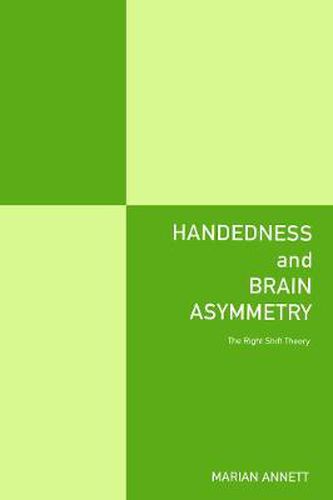
Brain asymmetry for speech is moderately related to handedness but what are the rules? Are symmetries for hand and brain associated with characteristics such as intelligence, motor skill, spatial reasoning or skill at sports? In this follow up to the influential Left, Right Hand and Brain (1985) Marian Annett draws on a working lifetime of research to help provide answers to crucial questions. Central to her argument is the Right Shift Theory - her original and innovative contribution to the field that seeks to explain the relationships between left-and right-handedness and left-and right-brain specialisation. The theory proposes that handedness in humans and our non-human primate relations depends on chance but that chance is weighted towards right-handedness in most people by an agent of right-hemisphere disadvantage. It argues for the existence of a single gene for right shift (RS+) that evolved in humans to aid the growth of speech in the left hemisphere of the brain. The Right Shift Theory has possible implications for a wide range of questions about human abilities and disabilities, including verbal and non verbal intelligence, educational progress and dyslexia, spatial reasoning, sporting skills and mental illness. It continues to be at the cutting edge of research, solving problems and generating new avenues of investigation - most recently the surprising idea that a mutant RS+ gene might be involved in the causes of schizophrenia and autism. Handedness and Brain Asymmetry will make fascinating reading for students and researchers in psychology and neurology, educationalists, and anyone with a keen interest in why people have different talents and weaknesses.
$9.00 standard shipping within Australia
FREE standard shipping within Australia for orders over $100.00
Express & International shipping calculated at checkout
Stock availability can be subject to change without notice. We recommend calling the shop or contacting our online team to check availability of low stock items. Please see our Shopping Online page for more details.
Brain asymmetry for speech is moderately related to handedness but what are the rules? Are symmetries for hand and brain associated with characteristics such as intelligence, motor skill, spatial reasoning or skill at sports? In this follow up to the influential Left, Right Hand and Brain (1985) Marian Annett draws on a working lifetime of research to help provide answers to crucial questions. Central to her argument is the Right Shift Theory - her original and innovative contribution to the field that seeks to explain the relationships between left-and right-handedness and left-and right-brain specialisation. The theory proposes that handedness in humans and our non-human primate relations depends on chance but that chance is weighted towards right-handedness in most people by an agent of right-hemisphere disadvantage. It argues for the existence of a single gene for right shift (RS+) that evolved in humans to aid the growth of speech in the left hemisphere of the brain. The Right Shift Theory has possible implications for a wide range of questions about human abilities and disabilities, including verbal and non verbal intelligence, educational progress and dyslexia, spatial reasoning, sporting skills and mental illness. It continues to be at the cutting edge of research, solving problems and generating new avenues of investigation - most recently the surprising idea that a mutant RS+ gene might be involved in the causes of schizophrenia and autism. Handedness and Brain Asymmetry will make fascinating reading for students and researchers in psychology and neurology, educationalists, and anyone with a keen interest in why people have different talents and weaknesses.
Search our extensive online catalogue.
