Readings Newsletter
Become a Readings Member to make your shopping experience even easier.
Sign in or sign up for free!
You’re not far away from qualifying for FREE standard shipping within Australia
You’ve qualified for FREE standard shipping within Australia
The cart is loading…


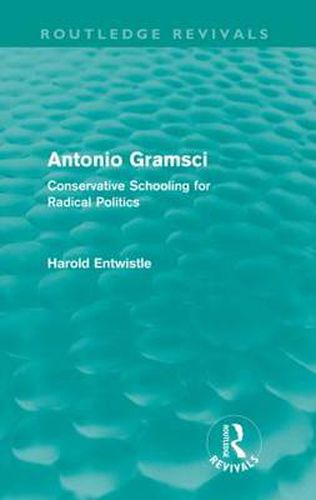
Antonio Gramsci is one of the few Marxist theoreticians to have considered the role and nature of education, yet paradoxically his revolutionary, political and social theory seems at odds with his conservative approach to the content and processes of schooling. This book, originally published in 1979, examines his educational, political and cultural writings in an effort to resolve this apparent discrepancy.
Gramsci’s relevance lies in his treatment, in the context of his radical political theory, of themes which currently exercise modern radical educationists. Among the subjects he discusses are the sociology of the curriculum, the apparent discontinuity between the culture of school and that of daily life, problems of literacy and language in education, the role of the state in the provision of education, the cultivation of elites and the role of intellectuals, the relative functions of authority and spontaneity in education and the ambiguious relationship of these to differing political ideologies, particularly Fascism.
$9.00 standard shipping within Australia
FREE standard shipping within Australia for orders over $100.00
Express & International shipping calculated at checkout
Stock availability can be subject to change without notice. We recommend calling the shop or contacting our online team to check availability of low stock items. Please see our Shopping Online page for more details.
Antonio Gramsci is one of the few Marxist theoreticians to have considered the role and nature of education, yet paradoxically his revolutionary, political and social theory seems at odds with his conservative approach to the content and processes of schooling. This book, originally published in 1979, examines his educational, political and cultural writings in an effort to resolve this apparent discrepancy.
Gramsci’s relevance lies in his treatment, in the context of his radical political theory, of themes which currently exercise modern radical educationists. Among the subjects he discusses are the sociology of the curriculum, the apparent discontinuity between the culture of school and that of daily life, problems of literacy and language in education, the role of the state in the provision of education, the cultivation of elites and the role of intellectuals, the relative functions of authority and spontaneity in education and the ambiguious relationship of these to differing political ideologies, particularly Fascism.
Search our extensive online catalogue.
