Readings Newsletter
Become a Readings Member to make your shopping experience even easier.
Sign in or sign up for free!
You’re not far away from qualifying for FREE standard shipping within Australia
You’ve qualified for FREE standard shipping within Australia
The cart is loading…


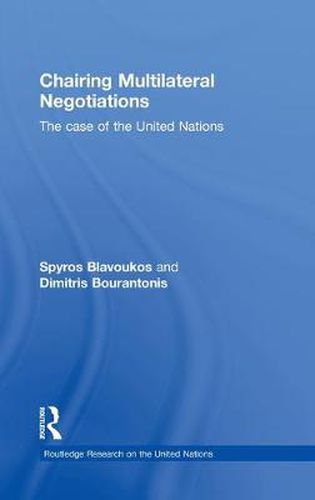
This book examines the important role of the chairmanship office in multilateral negotiations within the UN setting. Although chairmanship is a generic feature of international politics, negotiations, and decision-making, it has been scarcely researched. The neutrality and impartiality assumptions that have been long associated with the chair have veiled the chair’s potential in moulding negotiation outcomes.
The authors seek to develop an analytical framework for the systematic study of the chairmanship office and its potential impact on multilateral negotiations. It elaborates on its origins, the parameters and conditions of chair’s effectiveness, and the performance of the chair’s functions. Focusing on the UN, this work seeks to go beyond existing accounts, offering further insights and extending the discussion beyond the Security Council. Without ignoring the pivotal importance of the Security Council, the book broadens the scope of analysis to other significant UN bodies and institutions including ad hoc Working Groups and several Conferences set up for specific international issues.
Evaluating material from a wide range of sources and providing a deeper understanding of UN political dynamics, this work will appeal to scholars of the UN system, international organisations and global governance.
$9.00 standard shipping within Australia
FREE standard shipping within Australia for orders over $100.00
Express & International shipping calculated at checkout
Stock availability can be subject to change without notice. We recommend calling the shop or contacting our online team to check availability of low stock items. Please see our Shopping Online page for more details.
This book examines the important role of the chairmanship office in multilateral negotiations within the UN setting. Although chairmanship is a generic feature of international politics, negotiations, and decision-making, it has been scarcely researched. The neutrality and impartiality assumptions that have been long associated with the chair have veiled the chair’s potential in moulding negotiation outcomes.
The authors seek to develop an analytical framework for the systematic study of the chairmanship office and its potential impact on multilateral negotiations. It elaborates on its origins, the parameters and conditions of chair’s effectiveness, and the performance of the chair’s functions. Focusing on the UN, this work seeks to go beyond existing accounts, offering further insights and extending the discussion beyond the Security Council. Without ignoring the pivotal importance of the Security Council, the book broadens the scope of analysis to other significant UN bodies and institutions including ad hoc Working Groups and several Conferences set up for specific international issues.
Evaluating material from a wide range of sources and providing a deeper understanding of UN political dynamics, this work will appeal to scholars of the UN system, international organisations and global governance.
Search our extensive online catalogue.
