Readings Newsletter
Become a Readings Member to make your shopping experience even easier.
Sign in or sign up for free!
You’re not far away from qualifying for FREE standard shipping within Australia
You’ve qualified for FREE standard shipping within Australia
The cart is loading…


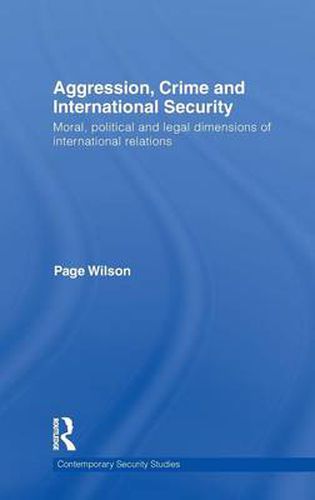
Aggression, Crime and International Security examines the concept of aggression in international relations and how it has been dealt with by international law and collective security organisations.
This book analyses the evolution of the concept of aggression in international relations from World War I to the post-Rome Statute era. It charts the emergence of two competing visions of this notion: on the one hand, as a triggering mechanism for collective security enforcement among states, and, on the other, as an international crime giving rise to individual responsibility. The author argues that despite certain contemporary international trends suggesting a shift away from traditional, state-centric power structures towards a more cosmopolitan, globalized polity, the history of the concept of aggression demonstrates just how far away this is in reality. By examining aggression in theory and practice at the League of Nations, the Nuremberg and Tokyo Trials, the United Nations, the conference establishing the Rome Statute, and beyond, the book reveals the recurring moral, political and legal challenges this concept poses - challenges which continue to be at the forefront of thinking about international relations today.
This book will be of great interest to students of International Law, War Crimes, International Relations and Security Studies.
$9.00 standard shipping within Australia
FREE standard shipping within Australia for orders over $100.00
Express & International shipping calculated at checkout
Stock availability can be subject to change without notice. We recommend calling the shop or contacting our online team to check availability of low stock items. Please see our Shopping Online page for more details.
Aggression, Crime and International Security examines the concept of aggression in international relations and how it has been dealt with by international law and collective security organisations.
This book analyses the evolution of the concept of aggression in international relations from World War I to the post-Rome Statute era. It charts the emergence of two competing visions of this notion: on the one hand, as a triggering mechanism for collective security enforcement among states, and, on the other, as an international crime giving rise to individual responsibility. The author argues that despite certain contemporary international trends suggesting a shift away from traditional, state-centric power structures towards a more cosmopolitan, globalized polity, the history of the concept of aggression demonstrates just how far away this is in reality. By examining aggression in theory and practice at the League of Nations, the Nuremberg and Tokyo Trials, the United Nations, the conference establishing the Rome Statute, and beyond, the book reveals the recurring moral, political and legal challenges this concept poses - challenges which continue to be at the forefront of thinking about international relations today.
This book will be of great interest to students of International Law, War Crimes, International Relations and Security Studies.
Search our extensive online catalogue.
