Readings Newsletter
Become a Readings Member to make your shopping experience even easier.
Sign in or sign up for free!
You’re not far away from qualifying for FREE standard shipping within Australia
You’ve qualified for FREE standard shipping within Australia
The cart is loading…


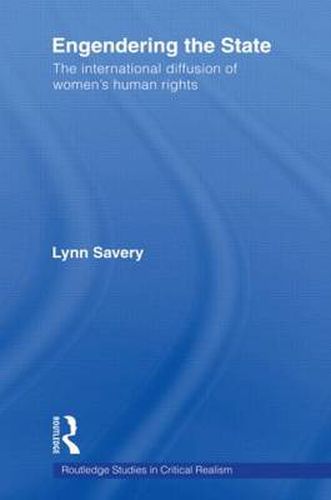
Why have states in general been slower to incorporate the international diffusion of women’s human rights norms domestically than other human rights norms and why has the diffusion of these norms varied so greatly between states? Why are some states more responsive and exert more effort than others to comply with these norms?
Engendering the State explains these key issues and argues that the gender biased identity of many states represents the most significant barrier to diffusion. It also explores how particular norms have diffused into certain states at specific points in time, as a consequence of international and domestic pressure.
The author:
addresses the limitations of existing explanations of international norms
case studies of Germany, Spain, Japan and India, which provide a new perspective on comparative analysis of Europe and Asia
alternative arguments on cross-national variation and the influence of international norms of sexual discrimination
the theoretical and practical implications of the argument.
This book is essential to those with an interest in the topical subject of women’s human rights, gender studies and international studies.
$9.00 standard shipping within Australia
FREE standard shipping within Australia for orders over $100.00
Express & International shipping calculated at checkout
Why have states in general been slower to incorporate the international diffusion of women’s human rights norms domestically than other human rights norms and why has the diffusion of these norms varied so greatly between states? Why are some states more responsive and exert more effort than others to comply with these norms?
Engendering the State explains these key issues and argues that the gender biased identity of many states represents the most significant barrier to diffusion. It also explores how particular norms have diffused into certain states at specific points in time, as a consequence of international and domestic pressure.
The author:
addresses the limitations of existing explanations of international norms
case studies of Germany, Spain, Japan and India, which provide a new perspective on comparative analysis of Europe and Asia
alternative arguments on cross-national variation and the influence of international norms of sexual discrimination
the theoretical and practical implications of the argument.
This book is essential to those with an interest in the topical subject of women’s human rights, gender studies and international studies.
Search our extensive online catalogue.
