Readings Newsletter
Become a Readings Member to make your shopping experience even easier.
Sign in or sign up for free!
You’re not far away from qualifying for FREE standard shipping within Australia
You’ve qualified for FREE standard shipping within Australia
The cart is loading…


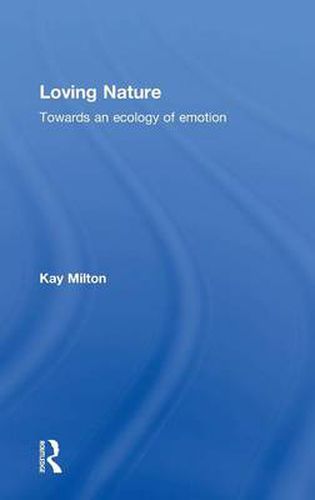
As the full effects of human activity on Earth’s life-support systems are revealed by science, the question of whether we can change, fundamentally, our relationship with nature becomes increasingly urgent. Just as important as an understanding of our environment, is an understanding of ourselves, of the kinds of beings we are and why we act as we do. In Loving Nature Kay Milton considers why some people in Western societies grow up to be nature lovers, actively concerned about the welfare and future of plants, animals, ecosystems and nature in general, while others seem indifferent or intent on destroying these things. Drawing on findings and ideas from anthropology, psychology, cognitive science and philosophy, the author discusses how we come to understand nature as we do, and above all, how we develop emotional commitments to it. Anthropologists, in recent years, have tended to suggest that our understanding of the world is shaped solely by the culture in which we live. Controversially Kay Milton argues that it is shaped by direct experience in which emotion plays an essential role. The author argues that the conventional opposition between emotion and rationality in western culture is a myth. The effect of this myth has been to support a market economy which systematically destroys nature, and to exclude from public decision making the kinds of emotional attachments that support more environmentally sensitive ways of living. A better understanding of ourselves, as fundamentally emotional beings, could give such ways of living the respect they need.
$9.00 standard shipping within Australia
FREE standard shipping within Australia for orders over $100.00
Express & International shipping calculated at checkout
Stock availability can be subject to change without notice. We recommend calling the shop or contacting our online team to check availability of low stock items. Please see our Shopping Online page for more details.
As the full effects of human activity on Earth’s life-support systems are revealed by science, the question of whether we can change, fundamentally, our relationship with nature becomes increasingly urgent. Just as important as an understanding of our environment, is an understanding of ourselves, of the kinds of beings we are and why we act as we do. In Loving Nature Kay Milton considers why some people in Western societies grow up to be nature lovers, actively concerned about the welfare and future of plants, animals, ecosystems and nature in general, while others seem indifferent or intent on destroying these things. Drawing on findings and ideas from anthropology, psychology, cognitive science and philosophy, the author discusses how we come to understand nature as we do, and above all, how we develop emotional commitments to it. Anthropologists, in recent years, have tended to suggest that our understanding of the world is shaped solely by the culture in which we live. Controversially Kay Milton argues that it is shaped by direct experience in which emotion plays an essential role. The author argues that the conventional opposition between emotion and rationality in western culture is a myth. The effect of this myth has been to support a market economy which systematically destroys nature, and to exclude from public decision making the kinds of emotional attachments that support more environmentally sensitive ways of living. A better understanding of ourselves, as fundamentally emotional beings, could give such ways of living the respect they need.
Search our extensive online catalogue.
