Readings Newsletter
Become a Readings Member to make your shopping experience even easier.
Sign in or sign up for free!
You’re not far away from qualifying for FREE standard shipping within Australia
You’ve qualified for FREE standard shipping within Australia
The cart is loading…


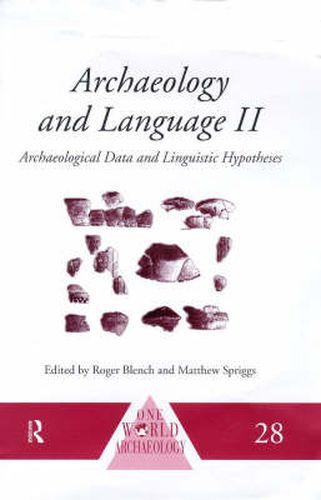
Using language to date the origin and spread of food production, Archaeology and Language II represents ground-breaking work in synthesising two disciplines that are now seen as interlinked: linguistics and archaeology. Archaeology and Lanaguage II examines in some detail how archaeological data can be interpreted through linguistic hypotheses. This collection demonstrates the possiblity that, where archaeological sequences are reasonably well-known, they might be tied into evidence of language diversification and thus produce absolute chronologies. Where there is evidence for migrations and expansions these can be explored through both disciplines to produce a richer interpretation of prehistory. Peter Bellwood, Dept. of Archaeology and Anthropology, Australian National University, Canberra, Australia, Roger Blench, CISPAL< Cambridge, UK, Bruce Connell, Institute of Socia
$9.00 standard shipping within Australia
FREE standard shipping within Australia for orders over $100.00
Express & International shipping calculated at checkout
Stock availability can be subject to change without notice. We recommend calling the shop or contacting our online team to check availability of low stock items. Please see our Shopping Online page for more details.
Using language to date the origin and spread of food production, Archaeology and Language II represents ground-breaking work in synthesising two disciplines that are now seen as interlinked: linguistics and archaeology. Archaeology and Lanaguage II examines in some detail how archaeological data can be interpreted through linguistic hypotheses. This collection demonstrates the possiblity that, where archaeological sequences are reasonably well-known, they might be tied into evidence of language diversification and thus produce absolute chronologies. Where there is evidence for migrations and expansions these can be explored through both disciplines to produce a richer interpretation of prehistory. Peter Bellwood, Dept. of Archaeology and Anthropology, Australian National University, Canberra, Australia, Roger Blench, CISPAL< Cambridge, UK, Bruce Connell, Institute of Socia
Search our extensive online catalogue.
