Readings Newsletter
Become a Readings Member to make your shopping experience even easier.
Sign in or sign up for free!
You’re not far away from qualifying for FREE standard shipping within Australia
You’ve qualified for FREE standard shipping within Australia
The cart is loading…


This title is printed to order. This book may have been self-published. If so, we cannot guarantee the quality of the content. In the main most books will have gone through the editing process however some may not. We therefore suggest that you be aware of this before ordering this book. If in doubt check either the author or publisher’s details as we are unable to accept any returns unless they are faulty. Please contact us if you have any questions.
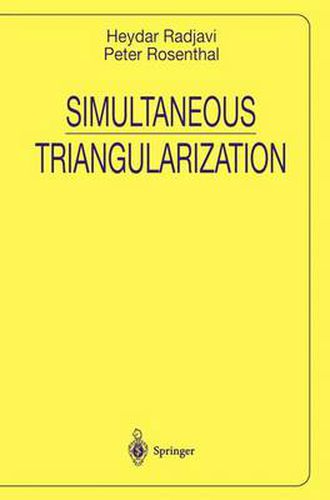
A collection of matrices is said to be triangularizable if there is an invertible matrix S such that S1 AS is upper triangular for every A in the collection. This generalization of commutativity is the subject of many classical theorems due to Engel, Kolchin, Kaplansky, McCoy and others. The concept has been extended to collections of bounded linear operators on Banach spaces: such a collection is defined to be triangularizable if there is a maximal chain of subspaces of the Banach space, each of which is invariant under every member of the collection. Most of the classical results have been generalized to compact operators, and there are also recent theorems in the finite-dimensional case. This book is the first comprehensive treatment of triangularizability in both the finite and infinite-dimensional cases. It contains numerous very recent results and new proofs of many of the classical theorems. It provides a thorough background for research in both the linear-algebraic and operator-theoretic aspects of triangularizability and related areas. More generally, the book will be useful to anyone interested in matrices or operators, as many of the results are linked to other topics such as spectral mapping theorems, properties of spectral radii and traces, and the structure of semigroups and algebras of operators. It is essentially self-contained modulo solid courses in linear algebra (for the first half) and functional analysis (for the second half), and is therefore suitable as a text or reference for a graduate course.
$9.00 standard shipping within Australia
FREE standard shipping within Australia for orders over $100.00
Express & International shipping calculated at checkout
Stock availability can be subject to change without notice. We recommend calling the shop or contacting our online team to check availability of low stock items. Please see our Shopping Online page for more details.
This title is printed to order. This book may have been self-published. If so, we cannot guarantee the quality of the content. In the main most books will have gone through the editing process however some may not. We therefore suggest that you be aware of this before ordering this book. If in doubt check either the author or publisher’s details as we are unable to accept any returns unless they are faulty. Please contact us if you have any questions.
A collection of matrices is said to be triangularizable if there is an invertible matrix S such that S1 AS is upper triangular for every A in the collection. This generalization of commutativity is the subject of many classical theorems due to Engel, Kolchin, Kaplansky, McCoy and others. The concept has been extended to collections of bounded linear operators on Banach spaces: such a collection is defined to be triangularizable if there is a maximal chain of subspaces of the Banach space, each of which is invariant under every member of the collection. Most of the classical results have been generalized to compact operators, and there are also recent theorems in the finite-dimensional case. This book is the first comprehensive treatment of triangularizability in both the finite and infinite-dimensional cases. It contains numerous very recent results and new proofs of many of the classical theorems. It provides a thorough background for research in both the linear-algebraic and operator-theoretic aspects of triangularizability and related areas. More generally, the book will be useful to anyone interested in matrices or operators, as many of the results are linked to other topics such as spectral mapping theorems, properties of spectral radii and traces, and the structure of semigroups and algebras of operators. It is essentially self-contained modulo solid courses in linear algebra (for the first half) and functional analysis (for the second half), and is therefore suitable as a text or reference for a graduate course.
Search our extensive online catalogue.
