Readings Newsletter
Become a Readings Member to make your shopping experience even easier.
Sign in or sign up for free!
You’re not far away from qualifying for FREE standard shipping within Australia
You’ve qualified for FREE standard shipping within Australia
The cart is loading…


This title is printed to order. This book may have been self-published. If so, we cannot guarantee the quality of the content. In the main most books will have gone through the editing process however some may not. We therefore suggest that you be aware of this before ordering this book. If in doubt check either the author or publisher’s details as we are unable to accept any returns unless they are faulty. Please contact us if you have any questions.
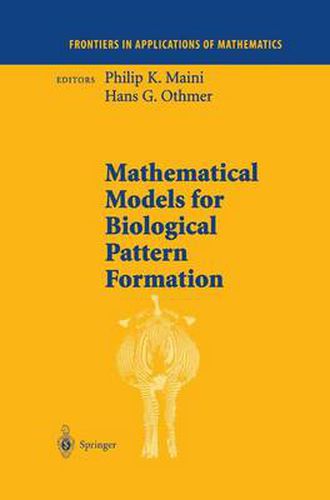
The formation of patterns in developing biological systems involves the spatio-temporal coordination of growth, cell-cell signalling, tissue movement, gene expression and cell differentiation. The interactions of these complex processes are generally nonlinear, and this mathematical modelling and analysis are needed to provide the framework in which to compute the outcome of different hypothesis on modes of interaction and to make experimentally testable predictions. This collection contains papers exploring several aspects of the hierarchy of processes occurring during pattern formation. A number of papers address the modelling of cell movement and deformation, with application to pattern formation within a collection of cells in response to external signalling cues. The results are considered in the context of pattern generation in Dictyostelium discoideum and bacterial colonies. A number of models at the macroscopic level explore the possible mechanisms underlying spatio-temporal pattern generation in early development, focussing on primitive streak, somitogenesis, vertebrate limb development and pigmentation patterning. The latter two applications consider in detail the effects of growth on patterning. The potential of models to generate more complex patterns are considered and models involving different modes of cell-cell signalling are investigated. Pattern selection is analyzed in the context of chemical Turing patterns, which serve as a paradigm for morphogenesis and a model for vegetation patterns is presented.
$9.00 standard shipping within Australia
FREE standard shipping within Australia for orders over $100.00
Express & International shipping calculated at checkout
Stock availability can be subject to change without notice. We recommend calling the shop or contacting our online team to check availability of low stock items. Please see our Shopping Online page for more details.
This title is printed to order. This book may have been self-published. If so, we cannot guarantee the quality of the content. In the main most books will have gone through the editing process however some may not. We therefore suggest that you be aware of this before ordering this book. If in doubt check either the author or publisher’s details as we are unable to accept any returns unless they are faulty. Please contact us if you have any questions.
The formation of patterns in developing biological systems involves the spatio-temporal coordination of growth, cell-cell signalling, tissue movement, gene expression and cell differentiation. The interactions of these complex processes are generally nonlinear, and this mathematical modelling and analysis are needed to provide the framework in which to compute the outcome of different hypothesis on modes of interaction and to make experimentally testable predictions. This collection contains papers exploring several aspects of the hierarchy of processes occurring during pattern formation. A number of papers address the modelling of cell movement and deformation, with application to pattern formation within a collection of cells in response to external signalling cues. The results are considered in the context of pattern generation in Dictyostelium discoideum and bacterial colonies. A number of models at the macroscopic level explore the possible mechanisms underlying spatio-temporal pattern generation in early development, focussing on primitive streak, somitogenesis, vertebrate limb development and pigmentation patterning. The latter two applications consider in detail the effects of growth on patterning. The potential of models to generate more complex patterns are considered and models involving different modes of cell-cell signalling are investigated. Pattern selection is analyzed in the context of chemical Turing patterns, which serve as a paradigm for morphogenesis and a model for vegetation patterns is presented.
Search our extensive online catalogue.
