Readings Newsletter
Become a Readings Member to make your shopping experience even easier.
Sign in or sign up for free!
You’re not far away from qualifying for FREE standard shipping within Australia
You’ve qualified for FREE standard shipping within Australia
The cart is loading…


This title is printed to order. This book may have been self-published. If so, we cannot guarantee the quality of the content. In the main most books will have gone through the editing process however some may not. We therefore suggest that you be aware of this before ordering this book. If in doubt check either the author or publisher’s details as we are unable to accept any returns unless they are faulty. Please contact us if you have any questions.
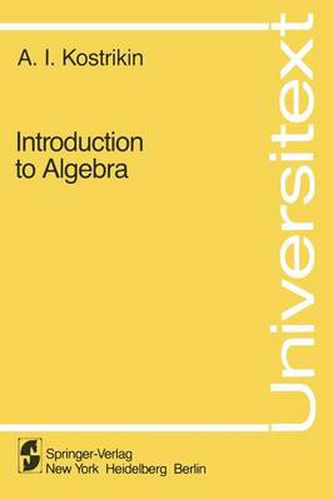
This textbook, written by a dedicated and successful pedagogue who developed the present undergraduate algebra course at Moscow State University, differs in several respects from other algebra textbooks available in English. The book reflects the Soviet approach to teaching mathematics with its emphasis on applications and problem-solving – note that the mathematics department in Moscow is called the I~echanics-Mathematics Faculty. In the first place, Kostrikin’s textbook motivates many of the algebraic concepts by practical examples, for instance, the heated plate problem used to introduce linear equations in Chapter 1. In the second place, there are a large number of exercises, so that the student can convert a vague passive understanding to active mastery of the new ideas. Thes~ problems are intended to be challenging but doable by the student; the harder ones have hints at the back of the book. This feature also makes the book ideally suited for learning algebra on one’s own outside of the framework of an organized course. In the third place, the author treats material which is usually not part of an elementary course but which is fundamental in applications. Thus, Part II includes an introduction to the classical groups and to representation theory. With many American colleges now trying to bring their undergraduate mathematics curriculum closer to applications, it seems worthwhile to translate Soviet textbooks which reflect their greater experience in this area of mathematical pedagogy.
$9.00 standard shipping within Australia
FREE standard shipping within Australia for orders over $100.00
Express & International shipping calculated at checkout
Stock availability can be subject to change without notice. We recommend calling the shop or contacting our online team to check availability of low stock items. Please see our Shopping Online page for more details.
This title is printed to order. This book may have been self-published. If so, we cannot guarantee the quality of the content. In the main most books will have gone through the editing process however some may not. We therefore suggest that you be aware of this before ordering this book. If in doubt check either the author or publisher’s details as we are unable to accept any returns unless they are faulty. Please contact us if you have any questions.
This textbook, written by a dedicated and successful pedagogue who developed the present undergraduate algebra course at Moscow State University, differs in several respects from other algebra textbooks available in English. The book reflects the Soviet approach to teaching mathematics with its emphasis on applications and problem-solving – note that the mathematics department in Moscow is called the I~echanics-Mathematics Faculty. In the first place, Kostrikin’s textbook motivates many of the algebraic concepts by practical examples, for instance, the heated plate problem used to introduce linear equations in Chapter 1. In the second place, there are a large number of exercises, so that the student can convert a vague passive understanding to active mastery of the new ideas. Thes~ problems are intended to be challenging but doable by the student; the harder ones have hints at the back of the book. This feature also makes the book ideally suited for learning algebra on one’s own outside of the framework of an organized course. In the third place, the author treats material which is usually not part of an elementary course but which is fundamental in applications. Thus, Part II includes an introduction to the classical groups and to representation theory. With many American colleges now trying to bring their undergraduate mathematics curriculum closer to applications, it seems worthwhile to translate Soviet textbooks which reflect their greater experience in this area of mathematical pedagogy.
Search our extensive online catalogue.
