Readings Newsletter
Become a Readings Member to make your shopping experience even easier.
Sign in or sign up for free!
You’re not far away from qualifying for FREE standard shipping within Australia
You’ve qualified for FREE standard shipping within Australia
The cart is loading…


This title is printed to order. This book may have been self-published. If so, we cannot guarantee the quality of the content. In the main most books will have gone through the editing process however some may not. We therefore suggest that you be aware of this before ordering this book. If in doubt check either the author or publisher’s details as we are unable to accept any returns unless they are faulty. Please contact us if you have any questions.
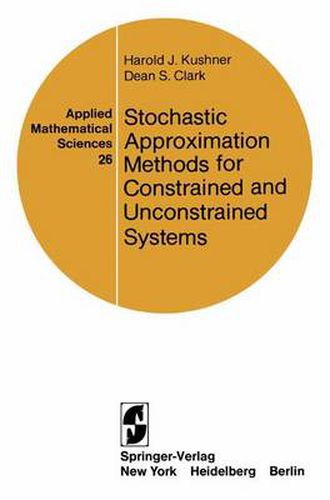
The book deals with a powerful and convenient approach to a great variety of types of problems of the recursive monte-carlo or stochastic approximation type. Such recu- sive algorithms occur frequently in stochastic and adaptive control and optimization theory and in statistical esti- tion theory. Typically, a sequence {X } of estimates of a n parameter is obtained by means of some recursive statistical th st procedure. The n estimate is some function of the n_l estimate and of some new observational data, and the aim is to study the convergence, rate of convergence, and the pa- metric dependence and other qualitative properties of the - gorithms. In this sense, the theory is a statistical version of recursive numerical analysis. The approach taken involves the use of relatively simple compactness methods. Most standard results for Kiefer-Wolfowitz and Robbins-Monro like methods are extended considerably. Constrained and unconstrained problems are treated, as is the rate of convergence problem. While the basic method is rather simple, it can be elaborated to allow a broad and deep coverage of stochastic approximation like problems. The approach, relating algorithm behavior to qualitative properties of deterministic or stochastic differ ential equations, has advantages in algorithm conceptualiza tion and design. It is often possible to obtain an intuitive understanding of algorithm behavior or qualitative dependence upon parameters, etc., without getting involved in a great deal of deta~l.
$9.00 standard shipping within Australia
FREE standard shipping within Australia for orders over $100.00
Express & International shipping calculated at checkout
Stock availability can be subject to change without notice. We recommend calling the shop or contacting our online team to check availability of low stock items. Please see our Shopping Online page for more details.
This title is printed to order. This book may have been self-published. If so, we cannot guarantee the quality of the content. In the main most books will have gone through the editing process however some may not. We therefore suggest that you be aware of this before ordering this book. If in doubt check either the author or publisher’s details as we are unable to accept any returns unless they are faulty. Please contact us if you have any questions.
The book deals with a powerful and convenient approach to a great variety of types of problems of the recursive monte-carlo or stochastic approximation type. Such recu- sive algorithms occur frequently in stochastic and adaptive control and optimization theory and in statistical esti- tion theory. Typically, a sequence {X } of estimates of a n parameter is obtained by means of some recursive statistical th st procedure. The n estimate is some function of the n_l estimate and of some new observational data, and the aim is to study the convergence, rate of convergence, and the pa- metric dependence and other qualitative properties of the - gorithms. In this sense, the theory is a statistical version of recursive numerical analysis. The approach taken involves the use of relatively simple compactness methods. Most standard results for Kiefer-Wolfowitz and Robbins-Monro like methods are extended considerably. Constrained and unconstrained problems are treated, as is the rate of convergence problem. While the basic method is rather simple, it can be elaborated to allow a broad and deep coverage of stochastic approximation like problems. The approach, relating algorithm behavior to qualitative properties of deterministic or stochastic differ ential equations, has advantages in algorithm conceptualiza tion and design. It is often possible to obtain an intuitive understanding of algorithm behavior or qualitative dependence upon parameters, etc., without getting involved in a great deal of deta~l.
Search our extensive online catalogue.
