Readings Newsletter
Become a Readings Member to make your shopping experience even easier.
Sign in or sign up for free!
You’re not far away from qualifying for FREE standard shipping within Australia
You’ve qualified for FREE standard shipping within Australia
The cart is loading…


This title is printed to order. This book may have been self-published. If so, we cannot guarantee the quality of the content. In the main most books will have gone through the editing process however some may not. We therefore suggest that you be aware of this before ordering this book. If in doubt check either the author or publisher’s details as we are unable to accept any returns unless they are faulty. Please contact us if you have any questions.
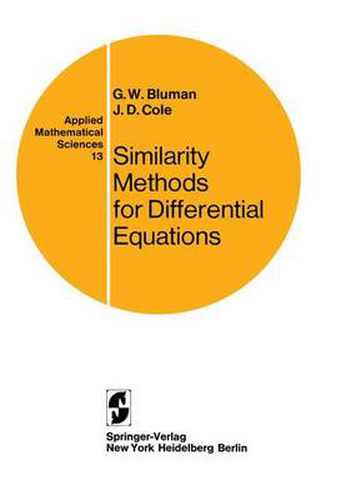
The aim of this book is to provide a systematic and practical account of methods of integration of ordinary and partial differential equations based on invariance under continuous (Lie) groups of trans formations. The goal of these methods is the expression of a solution in terms of quadrature in the case of ordinary differential equations of first order and a reduction in order for higher order equations. For partial differential equations at least a reduction in the number of independent variables is sought and in favorable cases a reduction to ordinary differential equations with special solutions or quadrature. In the last century, approximately one hundred years ago, Sophus Lie tried to construct a general integration theory, in the above sense, for ordinary differential equations. Following Abel’s approach for algebraic equations he studied the invariance of ordinary differential equations under transformations. In particular, Lie introduced the study of continuous groups of transformations of ordinary differential equations, based on the infinitesimal properties of the group. In a sense the theory was completely successful. It was shown how for a first-order differential equation the knowledge of a group leads immediately to quadrature, and for a higher order equation (or system) to a reduction in order. In another sense this theory is somewhat disappointing in that for a first-order differ ential equation essentially no systematic way can be given for finding the groups or showing that they do not exist for a first-order differential equation.
$9.00 standard shipping within Australia
FREE standard shipping within Australia for orders over $100.00
Express & International shipping calculated at checkout
Stock availability can be subject to change without notice. We recommend calling the shop or contacting our online team to check availability of low stock items. Please see our Shopping Online page for more details.
This title is printed to order. This book may have been self-published. If so, we cannot guarantee the quality of the content. In the main most books will have gone through the editing process however some may not. We therefore suggest that you be aware of this before ordering this book. If in doubt check either the author or publisher’s details as we are unable to accept any returns unless they are faulty. Please contact us if you have any questions.
The aim of this book is to provide a systematic and practical account of methods of integration of ordinary and partial differential equations based on invariance under continuous (Lie) groups of trans formations. The goal of these methods is the expression of a solution in terms of quadrature in the case of ordinary differential equations of first order and a reduction in order for higher order equations. For partial differential equations at least a reduction in the number of independent variables is sought and in favorable cases a reduction to ordinary differential equations with special solutions or quadrature. In the last century, approximately one hundred years ago, Sophus Lie tried to construct a general integration theory, in the above sense, for ordinary differential equations. Following Abel’s approach for algebraic equations he studied the invariance of ordinary differential equations under transformations. In particular, Lie introduced the study of continuous groups of transformations of ordinary differential equations, based on the infinitesimal properties of the group. In a sense the theory was completely successful. It was shown how for a first-order differential equation the knowledge of a group leads immediately to quadrature, and for a higher order equation (or system) to a reduction in order. In another sense this theory is somewhat disappointing in that for a first-order differ ential equation essentially no systematic way can be given for finding the groups or showing that they do not exist for a first-order differential equation.
Search our extensive online catalogue.
