Readings Newsletter
Become a Readings Member to make your shopping experience even easier.
Sign in or sign up for free!
You’re not far away from qualifying for FREE standard shipping within Australia
You’ve qualified for FREE standard shipping within Australia
The cart is loading…


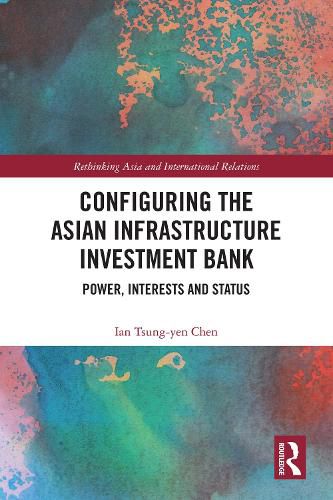
Studying the Asian Infrastructure Investment Bank (AIIB) through the lens of international relations (IR) theory, Chen argues that it is inappropriate to treat the AIIB as either a revisionist or a complementary institution.
Instead, the bank is still evolving and the interaction of power, interests, and status that will determine whether the bank will go wild. Theoretically, the current shape of the AIIB will influence global strategic conditions and global perceptions of the bank itself, consequently affecting China’s level of dissatisfaction with its power and status in the international financial system and maneuvering in the AIIB. To empirically show that, this book presents the evolution of the AIIB, compares the bank with its main competitors in the Asia-Pacific region, and conducts ten comparative case studies to show how countries around the world have positioned themselves in response to the emergence of the AIIB.
This book presents critical insights for scholars and foreign-policy practitioners to understand China’s surging influence in international organizations and how China can shape the world order. It should prove of interest to students and scholars of IR, strategic studies, China Studies, Asian Studies, developmental studies, economics, and global finance.
$9.00 standard shipping within Australia
FREE standard shipping within Australia for orders over $100.00
Express & International shipping calculated at checkout
Stock availability can be subject to change without notice. We recommend calling the shop or contacting our online team to check availability of low stock items. Please see our Shopping Online page for more details.
Studying the Asian Infrastructure Investment Bank (AIIB) through the lens of international relations (IR) theory, Chen argues that it is inappropriate to treat the AIIB as either a revisionist or a complementary institution.
Instead, the bank is still evolving and the interaction of power, interests, and status that will determine whether the bank will go wild. Theoretically, the current shape of the AIIB will influence global strategic conditions and global perceptions of the bank itself, consequently affecting China’s level of dissatisfaction with its power and status in the international financial system and maneuvering in the AIIB. To empirically show that, this book presents the evolution of the AIIB, compares the bank with its main competitors in the Asia-Pacific region, and conducts ten comparative case studies to show how countries around the world have positioned themselves in response to the emergence of the AIIB.
This book presents critical insights for scholars and foreign-policy practitioners to understand China’s surging influence in international organizations and how China can shape the world order. It should prove of interest to students and scholars of IR, strategic studies, China Studies, Asian Studies, developmental studies, economics, and global finance.
Search our extensive online catalogue.
