Readings Newsletter
Become a Readings Member to make your shopping experience even easier.
Sign in or sign up for free!
You’re not far away from qualifying for FREE standard shipping within Australia
You’ve qualified for FREE standard shipping within Australia
The cart is loading…


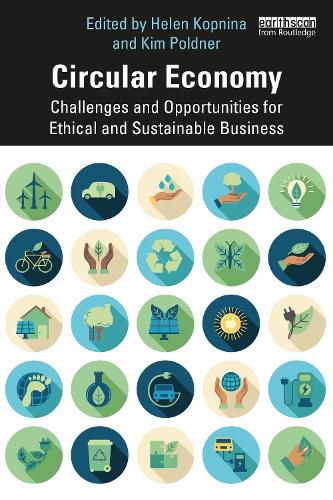
How can we design circular business models? How can we organize the transition from a linear to a circular economy? And how can we imagine circular futures that help us transform current realities? This book aims to provide answers to these questions while addressing the challenges and opportunities of the circular economy.
The authors reflect on why conventional sustainability models - such as the ‘triple P’ (People, Profit and Planet) or eco-efficiency - have failed in addressing environmental challenges, including climate change, biodiversity loss and pollution. They then move on to explore innovative circular business models, which propose to eliminate environmental damage by radically reforming the system of industrial production. Organizing the transition is a collaborative effort: entrepreneurs, consumers, policymakers, multinationals and intermediaries need to work together to foster the emergence of the circular economy as an institutional field. Together with younger generations of learners and equipped with beyond-human-centred values towards awareness of the material and natural world, novel circular futures can be imagined.
Offering points of reference for continued critical discourse and examples of practically applicable sustainability solutions, this book will be of great interest to students, teachers, practitioners and scholars of circular economy.
$9.00 standard shipping within Australia
FREE standard shipping within Australia for orders over $100.00
Express & International shipping calculated at checkout
Stock availability can be subject to change without notice. We recommend calling the shop or contacting our online team to check availability of low stock items. Please see our Shopping Online page for more details.
How can we design circular business models? How can we organize the transition from a linear to a circular economy? And how can we imagine circular futures that help us transform current realities? This book aims to provide answers to these questions while addressing the challenges and opportunities of the circular economy.
The authors reflect on why conventional sustainability models - such as the ‘triple P’ (People, Profit and Planet) or eco-efficiency - have failed in addressing environmental challenges, including climate change, biodiversity loss and pollution. They then move on to explore innovative circular business models, which propose to eliminate environmental damage by radically reforming the system of industrial production. Organizing the transition is a collaborative effort: entrepreneurs, consumers, policymakers, multinationals and intermediaries need to work together to foster the emergence of the circular economy as an institutional field. Together with younger generations of learners and equipped with beyond-human-centred values towards awareness of the material and natural world, novel circular futures can be imagined.
Offering points of reference for continued critical discourse and examples of practically applicable sustainability solutions, this book will be of great interest to students, teachers, practitioners and scholars of circular economy.
Search our extensive online catalogue.
