Readings Newsletter
Become a Readings Member to make your shopping experience even easier.
Sign in or sign up for free!
You’re not far away from qualifying for FREE standard shipping within Australia
You’ve qualified for FREE standard shipping within Australia
The cart is loading…


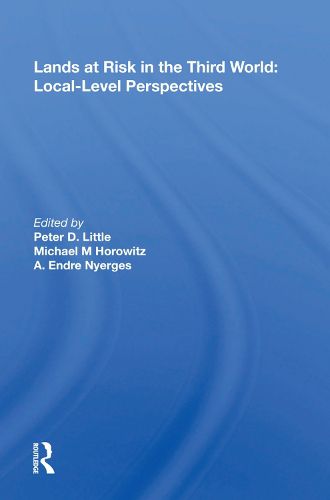
This book presents important case studies highlighting social, economic, political, and biological dimensions of environmental degradation in the Third World. Focusing on areas identified as experiencing or at risk for deterioration, the studies are drawn from nearly every continent and cover most of the larger ecosystems of the Third World, including arid and semiarid rangelands, tropical rain forests, steep-sloped mountains and hills, tropical river basins, and coastal lowlands. The authors use local data to examine, test, and refine larger explanatory models and theories, showing how comparisons of case-specific data can sharpen our knowledge about resource use in areas at risk. In doing so, the authors address two critical questions: How can land degradation processes be identified and how can the human role in land degradation be separated from the effects of climate and other natural actions?
$9.00 standard shipping within Australia
FREE standard shipping within Australia for orders over $100.00
Express & International shipping calculated at checkout
Stock availability can be subject to change without notice. We recommend calling the shop or contacting our online team to check availability of low stock items. Please see our Shopping Online page for more details.
This book presents important case studies highlighting social, economic, political, and biological dimensions of environmental degradation in the Third World. Focusing on areas identified as experiencing or at risk for deterioration, the studies are drawn from nearly every continent and cover most of the larger ecosystems of the Third World, including arid and semiarid rangelands, tropical rain forests, steep-sloped mountains and hills, tropical river basins, and coastal lowlands. The authors use local data to examine, test, and refine larger explanatory models and theories, showing how comparisons of case-specific data can sharpen our knowledge about resource use in areas at risk. In doing so, the authors address two critical questions: How can land degradation processes be identified and how can the human role in land degradation be separated from the effects of climate and other natural actions?
Search our extensive online catalogue.
