Readings Newsletter
Become a Readings Member to make your shopping experience even easier.
Sign in or sign up for free!
You’re not far away from qualifying for FREE standard shipping within Australia
You’ve qualified for FREE standard shipping within Australia
The cart is loading…


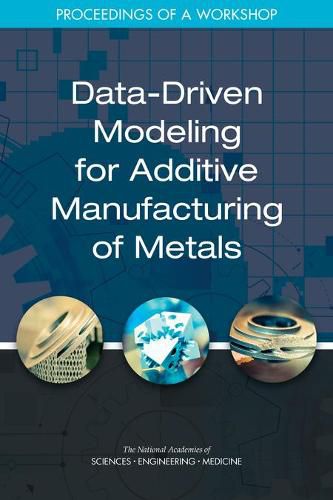
Additive manufacturing (AM) is the process in which a three-dimensional object is built by adding subsequent layers of materials. AM enables novel material compositions and shapes, often without the need for specialized tooling. This technology has the potential to revolutionize how mechanical parts are created, tested, and certified. However, successful real-time AM design requires the integration of complex systems and often necessitates expertise across domains. Simulation-based design approaches, such as those applied in engineering product design and material design, have the potential to improve AM predictive modeling capabilities, particularly when combined with existing knowledge of the underlying mechanics. These predictive models have the potential to reduce the cost of and time for concept-to-final-product development and can be used to supplement experimental tests.
The National Academies convened a workshop on October 24-26, 2018 to discuss the frontiers of mechanistic data-driven modeling for AM of metals. Topics of discussion included measuring and modeling process monitoring and control, developing models to represent microstructure evolution, alloy design, and part suitability, modeling phases of process and machine design, and accelerating product and process qualification and certification. These topics then led to the assessment of short-, immediate-, and long-term challenges in AM. This publication summarizes the presentations and discussions from the workshop.
$9.00 standard shipping within Australia
FREE standard shipping within Australia for orders over $100.00
Express & International shipping calculated at checkout
Stock availability can be subject to change without notice. We recommend calling the shop or contacting our online team to check availability of low stock items. Please see our Shopping Online page for more details.
Additive manufacturing (AM) is the process in which a three-dimensional object is built by adding subsequent layers of materials. AM enables novel material compositions and shapes, often without the need for specialized tooling. This technology has the potential to revolutionize how mechanical parts are created, tested, and certified. However, successful real-time AM design requires the integration of complex systems and often necessitates expertise across domains. Simulation-based design approaches, such as those applied in engineering product design and material design, have the potential to improve AM predictive modeling capabilities, particularly when combined with existing knowledge of the underlying mechanics. These predictive models have the potential to reduce the cost of and time for concept-to-final-product development and can be used to supplement experimental tests.
The National Academies convened a workshop on October 24-26, 2018 to discuss the frontiers of mechanistic data-driven modeling for AM of metals. Topics of discussion included measuring and modeling process monitoring and control, developing models to represent microstructure evolution, alloy design, and part suitability, modeling phases of process and machine design, and accelerating product and process qualification and certification. These topics then led to the assessment of short-, immediate-, and long-term challenges in AM. This publication summarizes the presentations and discussions from the workshop.
Search our extensive online catalogue.
