Readings Newsletter
Become a Readings Member to make your shopping experience even easier.
Sign in or sign up for free!
You’re not far away from qualifying for FREE standard shipping within Australia
You’ve qualified for FREE standard shipping within Australia
The cart is loading…


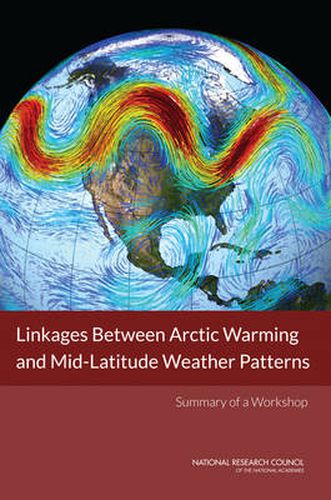
The Arctic has been undergoing significant changes in recent years. Average temperatures are rising twice as fast as they are elsewhere in the world. The extent and thickness of sea ice is rapidly declining. Such changes may have an impact on atmospheric conditions outside the region. Several hypotheses for how Arctic warming may be influencing mid-latitude weather patterns have been proposed recently. For example, Arctic warming could lead to a weakened jet stream resulting in more persistent weather patterns in the mid-latitudes. Or Arctic sea ice loss could lead to an increase of snow on high-latitude land, which in turn impacts the jet stream resulting in cold Eurasian and North American winters. These and other potential connections between a warming Arctic and mid-latitude weather are the subject of active research.
Linkages Between Arctic Warming and Mid-Latitude Weather Patterns is the summary of a workshop convened in September 2013 by the National Research Council to review our current understanding and to discuss research needed to better understand proposed linkages. A diverse array of experts examined linkages between a warming Arctic and mid-latitude weather patterns. The workshop included presentations from leading researchers representing a range of views on this topic. The workshop was organized to allow participants to take a global perspective and consider the influence of the Arctic in the context of forcing from other components of the climate system, such as changes in the tropics, ocean circulation, and mid-latitude sea surface temperature. This report discusses our current understanding of the mechanisms that link declines in Arctic sea ice cover, loss of high-latitude snow cover, changes in Arctic-region energy fluxes, atmospheric circulation patterns, and the occurrence of extreme weather events; possible implications of more severe loss of summer Arctic sea ice upon weather patterns at lower latitudes; major gaps in our understanding, and observational and/or modeling efforts that are needed to fill those gaps; and current opportunities and limitations for using Arctic sea ice predictions to assess the risk of temperature/precipitation anomalies and extreme weather events over northern continents.
$9.00 standard shipping within Australia
FREE standard shipping within Australia for orders over $100.00
Express & International shipping calculated at checkout
Stock availability can be subject to change without notice. We recommend calling the shop or contacting our online team to check availability of low stock items. Please see our Shopping Online page for more details.
The Arctic has been undergoing significant changes in recent years. Average temperatures are rising twice as fast as they are elsewhere in the world. The extent and thickness of sea ice is rapidly declining. Such changes may have an impact on atmospheric conditions outside the region. Several hypotheses for how Arctic warming may be influencing mid-latitude weather patterns have been proposed recently. For example, Arctic warming could lead to a weakened jet stream resulting in more persistent weather patterns in the mid-latitudes. Or Arctic sea ice loss could lead to an increase of snow on high-latitude land, which in turn impacts the jet stream resulting in cold Eurasian and North American winters. These and other potential connections between a warming Arctic and mid-latitude weather are the subject of active research.
Linkages Between Arctic Warming and Mid-Latitude Weather Patterns is the summary of a workshop convened in September 2013 by the National Research Council to review our current understanding and to discuss research needed to better understand proposed linkages. A diverse array of experts examined linkages between a warming Arctic and mid-latitude weather patterns. The workshop included presentations from leading researchers representing a range of views on this topic. The workshop was organized to allow participants to take a global perspective and consider the influence of the Arctic in the context of forcing from other components of the climate system, such as changes in the tropics, ocean circulation, and mid-latitude sea surface temperature. This report discusses our current understanding of the mechanisms that link declines in Arctic sea ice cover, loss of high-latitude snow cover, changes in Arctic-region energy fluxes, atmospheric circulation patterns, and the occurrence of extreme weather events; possible implications of more severe loss of summer Arctic sea ice upon weather patterns at lower latitudes; major gaps in our understanding, and observational and/or modeling efforts that are needed to fill those gaps; and current opportunities and limitations for using Arctic sea ice predictions to assess the risk of temperature/precipitation anomalies and extreme weather events over northern continents.
Search our extensive online catalogue.
