Readings Newsletter
Become a Readings Member to make your shopping experience even easier.
Sign in or sign up for free!
You’re not far away from qualifying for FREE standard shipping within Australia
You’ve qualified for FREE standard shipping within Australia
The cart is loading…


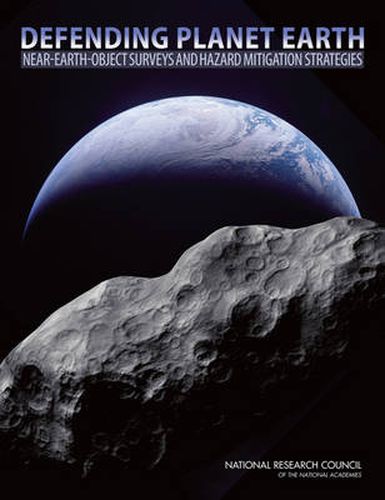
The United States spends approximately $4 million each year searching for near-Earth objects (NEOs). The objective is to detect those that may collide with Earth. The majority of this funding supports the operation of several observatories that scan the sky searching for NEOs. This, however, is insufficient in detecting the majority of NEOs that may present a tangible threat to humanity. A significantly smaller amount of funding supports ways to protect the Earth from such a potential collision or mitigation. In 2005, a Congressional mandate called for NASA to detect 90 percent of NEOs with diameters of 140 meters of greater by 2020. Defending Planet Earth: Near-Earth Object Surveys and Hazard Mitigation Strategies identifies the need for detection of objects as small as 30 to 50 meters as these can be highly destructive. The book explores four main types of mitigation including civil defense, slow push or pull methods, kinetic impactors and nuclear explosions. It also asserts that responding effectively to hazards posed by NEOs requires national and international cooperation. Defending Planet Earth: Near-Earth Object Surveys and Hazard Mitigation Strategies is a useful guide for scientists, astronomers, policy makers and engineers. –Publisher’s description.
$9.00 standard shipping within Australia
FREE standard shipping within Australia for orders over $100.00
Express & International shipping calculated at checkout
Stock availability can be subject to change without notice. We recommend calling the shop or contacting our online team to check availability of low stock items. Please see our Shopping Online page for more details.
The United States spends approximately $4 million each year searching for near-Earth objects (NEOs). The objective is to detect those that may collide with Earth. The majority of this funding supports the operation of several observatories that scan the sky searching for NEOs. This, however, is insufficient in detecting the majority of NEOs that may present a tangible threat to humanity. A significantly smaller amount of funding supports ways to protect the Earth from such a potential collision or mitigation. In 2005, a Congressional mandate called for NASA to detect 90 percent of NEOs with diameters of 140 meters of greater by 2020. Defending Planet Earth: Near-Earth Object Surveys and Hazard Mitigation Strategies identifies the need for detection of objects as small as 30 to 50 meters as these can be highly destructive. The book explores four main types of mitigation including civil defense, slow push or pull methods, kinetic impactors and nuclear explosions. It also asserts that responding effectively to hazards posed by NEOs requires national and international cooperation. Defending Planet Earth: Near-Earth Object Surveys and Hazard Mitigation Strategies is a useful guide for scientists, astronomers, policy makers and engineers. –Publisher’s description.
Search our extensive online catalogue.
