Readings Newsletter
Become a Readings Member to make your shopping experience even easier.
Sign in or sign up for free!
You’re not far away from qualifying for FREE standard shipping within Australia
You’ve qualified for FREE standard shipping within Australia
The cart is loading…


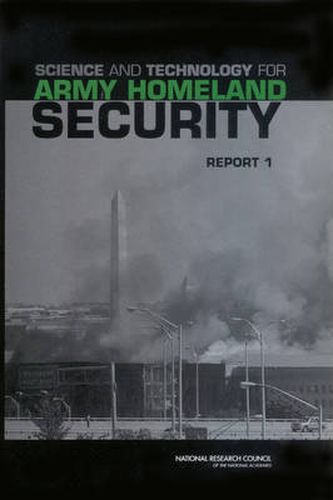
The confluence of the September 11, 2001 terrorist attack and the U.S. Army&s historic role to support civil authorities has resulted in substantial new challenges for the Army. To help meet these challenges, the Assistant Secretary of the Army for Research and Technology requested the National Research Council (NRC) carry out a series of studies on how science and technology could assist the Army prepare for its role in homeland security (HLS). The NRC&s Board on Army Science and Technology formed the Committee on Army Science and Technology for Homeland Security to accomplish that assignment. The Committee was asked to review relevant literature and activities, determine areas of emphasis for Army S&T in support of counter terrorism and anti-terrorism, and recommend high-payoff technologies to help the Army fulfill its mission. The Department of Defense Counter-Terrorism Technology Task Force identified four operational areas in reviewing technical proposals for HLS operations: indications and warning; denial and survivability; recovery and consequence management; and attribution and retaliation.The study sponsor asked the Committee to use these four areas as the basis for its assessment of the science and technology (S&T) that will be important for the Army&s HLS role. Overall, the Committee found that: - There is potential for substantial synergy between S&T work carried out by the Army for its HLS responsibilities and the development of the next generation Army, the Objective Force. - The Army National Guard (ARNG) is critical to the success of the Army&s HLS efforts.
$9.00 standard shipping within Australia
FREE standard shipping within Australia for orders over $100.00
Express & International shipping calculated at checkout
Stock availability can be subject to change without notice. We recommend calling the shop or contacting our online team to check availability of low stock items. Please see our Shopping Online page for more details.
The confluence of the September 11, 2001 terrorist attack and the U.S. Army&s historic role to support civil authorities has resulted in substantial new challenges for the Army. To help meet these challenges, the Assistant Secretary of the Army for Research and Technology requested the National Research Council (NRC) carry out a series of studies on how science and technology could assist the Army prepare for its role in homeland security (HLS). The NRC&s Board on Army Science and Technology formed the Committee on Army Science and Technology for Homeland Security to accomplish that assignment. The Committee was asked to review relevant literature and activities, determine areas of emphasis for Army S&T in support of counter terrorism and anti-terrorism, and recommend high-payoff technologies to help the Army fulfill its mission. The Department of Defense Counter-Terrorism Technology Task Force identified four operational areas in reviewing technical proposals for HLS operations: indications and warning; denial and survivability; recovery and consequence management; and attribution and retaliation.The study sponsor asked the Committee to use these four areas as the basis for its assessment of the science and technology (S&T) that will be important for the Army&s HLS role. Overall, the Committee found that: - There is potential for substantial synergy between S&T work carried out by the Army for its HLS responsibilities and the development of the next generation Army, the Objective Force. - The Army National Guard (ARNG) is critical to the success of the Army&s HLS efforts.
Search our extensive online catalogue.
