Readings Newsletter
Become a Readings Member to make your shopping experience even easier.
Sign in or sign up for free!
You’re not far away from qualifying for FREE standard shipping within Australia
You’ve qualified for FREE standard shipping within Australia
The cart is loading…


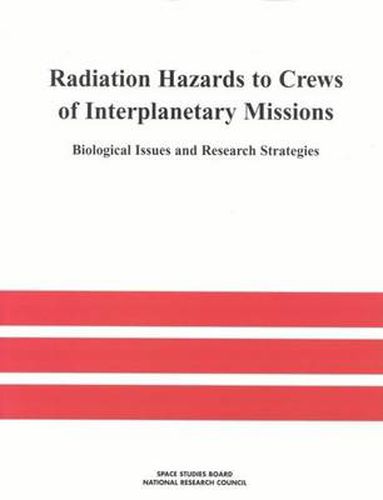
NASA’s long-range plans include possible human exploratory missions to the moon and Mars within the next quarter century. Such missions beyond low Earth orbit will expose crews to transient radiation from solar particle events as well as continuous high-energy galactic cosmic rays ranging from energetic protons with low mean linear energy transfer (LET) to nuclei with high atomic numbers, high energies, and high LET. Because the radiation levels in space are high and the missions long, adequate shielding is needed to minimize the deleterious health effects of exposure to radiation. The knowledge base needed to design shielding involves two sets of factors, each with quantitative uncertainty-the radiation spectra and doses present behind different types of shielding, and the effects of the doses on relevant biological systems. It is only prudent to design shielding that will protect the crew of spacecraft exposed to predicted high, but uncertain, levels of radiation and biological effects. Because of the uncertainties regarding the degree and type of radiation protection needed, a requirement for shielding to protect against large deleterious, but uncertain, biological effects may be imposed, which in turn could result in an unacceptable cost to a mission. It therefore is of interest to reduce these uncertainties in biological effects and shielding requirements for reasons of mission feasibility, safety, and cost.
$9.00 standard shipping within Australia
FREE standard shipping within Australia for orders over $100.00
Express & International shipping calculated at checkout
Stock availability can be subject to change without notice. We recommend calling the shop or contacting our online team to check availability of low stock items. Please see our Shopping Online page for more details.
NASA’s long-range plans include possible human exploratory missions to the moon and Mars within the next quarter century. Such missions beyond low Earth orbit will expose crews to transient radiation from solar particle events as well as continuous high-energy galactic cosmic rays ranging from energetic protons with low mean linear energy transfer (LET) to nuclei with high atomic numbers, high energies, and high LET. Because the radiation levels in space are high and the missions long, adequate shielding is needed to minimize the deleterious health effects of exposure to radiation. The knowledge base needed to design shielding involves two sets of factors, each with quantitative uncertainty-the radiation spectra and doses present behind different types of shielding, and the effects of the doses on relevant biological systems. It is only prudent to design shielding that will protect the crew of spacecraft exposed to predicted high, but uncertain, levels of radiation and biological effects. Because of the uncertainties regarding the degree and type of radiation protection needed, a requirement for shielding to protect against large deleterious, but uncertain, biological effects may be imposed, which in turn could result in an unacceptable cost to a mission. It therefore is of interest to reduce these uncertainties in biological effects and shielding requirements for reasons of mission feasibility, safety, and cost.
Search our extensive online catalogue.
