Readings Newsletter
Become a Readings Member to make your shopping experience even easier.
Sign in or sign up for free!
You’re not far away from qualifying for FREE standard shipping within Australia
You’ve qualified for FREE standard shipping within Australia
The cart is loading…


This title is printed to order. This book may have been self-published. If so, we cannot guarantee the quality of the content. In the main most books will have gone through the editing process however some may not. We therefore suggest that you be aware of this before ordering this book. If in doubt check either the author or publisher’s details as we are unable to accept any returns unless they are faulty. Please contact us if you have any questions.
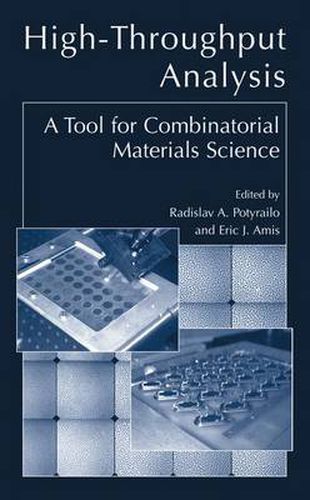
This book, edited by Potyrailo and Amis, addresses a new paradigm-shifting approach in the search for new materials-Combinatorial Materials Science. One way to consider such an approach is to imagine an adventurous chef who decides to look for new entrees by cooking food ingredients in many pots using different combinations in every pot, and boil ing, steaming, or frying them in various ways. Although most of the pots will not have the tastiest food ever devised, some recipes will taste intriguing, and some eventually will lead to a discovery of a new fascinating cuisine. Of course, having a skilled chef design the com binatorial formulation will certainly be helpful in ensuring a successful outcome. Similar to food, each engineering material is a complex product of its chemical composition, structure, and processing. Generally, each of these components matters—change one and you get another material. Most of these new materials will be less good than ones we use now since existing materials have been refined with the extensive work of scientists and engi neers. At the same time if one prepares diverse materials like our adventurous chef, chang ing material composition, processing conditions and time, etc. , some of these materials will be superior to existing ones and a few might represent breakout technology.
$9.00 standard shipping within Australia
FREE standard shipping within Australia for orders over $100.00
Express & International shipping calculated at checkout
Stock availability can be subject to change without notice. We recommend calling the shop or contacting our online team to check availability of low stock items. Please see our Shopping Online page for more details.
This title is printed to order. This book may have been self-published. If so, we cannot guarantee the quality of the content. In the main most books will have gone through the editing process however some may not. We therefore suggest that you be aware of this before ordering this book. If in doubt check either the author or publisher’s details as we are unable to accept any returns unless they are faulty. Please contact us if you have any questions.
This book, edited by Potyrailo and Amis, addresses a new paradigm-shifting approach in the search for new materials-Combinatorial Materials Science. One way to consider such an approach is to imagine an adventurous chef who decides to look for new entrees by cooking food ingredients in many pots using different combinations in every pot, and boil ing, steaming, or frying them in various ways. Although most of the pots will not have the tastiest food ever devised, some recipes will taste intriguing, and some eventually will lead to a discovery of a new fascinating cuisine. Of course, having a skilled chef design the com binatorial formulation will certainly be helpful in ensuring a successful outcome. Similar to food, each engineering material is a complex product of its chemical composition, structure, and processing. Generally, each of these components matters—change one and you get another material. Most of these new materials will be less good than ones we use now since existing materials have been refined with the extensive work of scientists and engi neers. At the same time if one prepares diverse materials like our adventurous chef, chang ing material composition, processing conditions and time, etc. , some of these materials will be superior to existing ones and a few might represent breakout technology.
Search our extensive online catalogue.
