Readings Newsletter
Become a Readings Member to make your shopping experience even easier.
Sign in or sign up for free!
You’re not far away from qualifying for FREE standard shipping within Australia
You’ve qualified for FREE standard shipping within Australia
The cart is loading…


This title is printed to order. This book may have been self-published. If so, we cannot guarantee the quality of the content. In the main most books will have gone through the editing process however some may not. We therefore suggest that you be aware of this before ordering this book. If in doubt check either the author or publisher’s details as we are unable to accept any returns unless they are faulty. Please contact us if you have any questions.
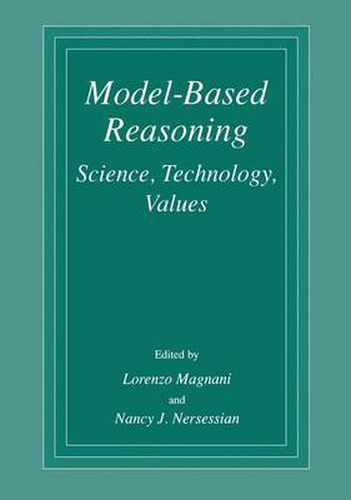
The study of diagnostic, visual, spatial, analogical, and temporal reasoning has demonstrated that there are many ways of performing intelligent and creative reasoning that cannot be described with the help of traditional notions of reasoning, such as classical logic. Understanding the contribution of modelling practices to discovery and conceptual change in science requires expanding scientific reasoning to include complex forms of creative reasoning that are not always successful and can lead to incorrect solutions. The study of these heuristic ways of reasoning is situated at the crossroads of philosophy, artificial intelligence, cognitive psychology, and logic; that is, at the heart of cognitive science. There are several key ingredients common to the various forms of model-based reasoning considered in this book. The term model comprises both internal and external representations. The models are intended as interpretations of target physical systems, processes, phenomena, or situations. The models are retrieved or constructed on the basis of potentially satisfying salient constraints of the target domain. Moreover, in the modelling process, various forms of abstraction are used. Evaluation and adaptation take place in the light of structural, causal, and/or functional constraints. Model simulation can be used to produce new states and enable evaluation of behaviours and other factors. The various contributions of the book are written by interdisciplinary researchers who are active in the area of creative reasoning in science and technology: the most recent results and achievements in the topics above are illustrated in the chapters.
$9.00 standard shipping within Australia
FREE standard shipping within Australia for orders over $100.00
Express & International shipping calculated at checkout
Stock availability can be subject to change without notice. We recommend calling the shop or contacting our online team to check availability of low stock items. Please see our Shopping Online page for more details.
This title is printed to order. This book may have been self-published. If so, we cannot guarantee the quality of the content. In the main most books will have gone through the editing process however some may not. We therefore suggest that you be aware of this before ordering this book. If in doubt check either the author or publisher’s details as we are unable to accept any returns unless they are faulty. Please contact us if you have any questions.
The study of diagnostic, visual, spatial, analogical, and temporal reasoning has demonstrated that there are many ways of performing intelligent and creative reasoning that cannot be described with the help of traditional notions of reasoning, such as classical logic. Understanding the contribution of modelling practices to discovery and conceptual change in science requires expanding scientific reasoning to include complex forms of creative reasoning that are not always successful and can lead to incorrect solutions. The study of these heuristic ways of reasoning is situated at the crossroads of philosophy, artificial intelligence, cognitive psychology, and logic; that is, at the heart of cognitive science. There are several key ingredients common to the various forms of model-based reasoning considered in this book. The term model comprises both internal and external representations. The models are intended as interpretations of target physical systems, processes, phenomena, or situations. The models are retrieved or constructed on the basis of potentially satisfying salient constraints of the target domain. Moreover, in the modelling process, various forms of abstraction are used. Evaluation and adaptation take place in the light of structural, causal, and/or functional constraints. Model simulation can be used to produce new states and enable evaluation of behaviours and other factors. The various contributions of the book are written by interdisciplinary researchers who are active in the area of creative reasoning in science and technology: the most recent results and achievements in the topics above are illustrated in the chapters.
Search our extensive online catalogue.
