Readings Newsletter
Become a Readings Member to make your shopping experience even easier.
Sign in or sign up for free!
You’re not far away from qualifying for FREE standard shipping within Australia
You’ve qualified for FREE standard shipping within Australia
The cart is loading…


This title is printed to order. This book may have been self-published. If so, we cannot guarantee the quality of the content. In the main most books will have gone through the editing process however some may not. We therefore suggest that you be aware of this before ordering this book. If in doubt check either the author or publisher’s details as we are unable to accept any returns unless they are faulty. Please contact us if you have any questions.
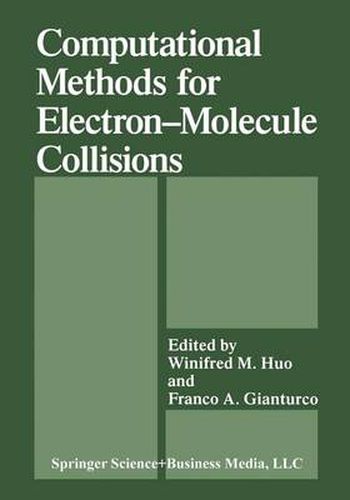
The collision of electrons with molecules and molecular ions is a fundamental pro cess in atomic and molecular physics and in chemistry. At high incident electron en ergies, electron-molecule collisions are used to deduce molecular geometries, oscillator strengths for optically allowed transitions, and in the case of electron-impact ionization, to probe the momentum distribution of the molecule itself. When the incident electron energy is comparable to or below those of the molecular valence electrons, the physics involved is particularly rich. Correlation and exchange effects necessary to describe such collision processes bear a close resemblance to similar efft:cts in the theory of electronic structure in molecules. Compound state formations, in the form of resonances and vir tual states, manifest themselves in experimental observables which provide details of the electron-molecule interactions. Ro-vibrational excitations by low-energy electron collisions exemplify energy transfer between the electronic and nuclear motion. The role of nonadiabatic interaction is raised here. When the final vibrational state is in the continuum, molecular dissociation occurs. Dissociative recombination and dissociative attachment are examples of such fragmentation processes. In addition to its fundamental nature, the study of electron-molecule collisions is also motivated by its relation to other fields of study and by its technological appli cations. The study of planetary atmospheres and the interstellar medium necessarily involve collision processes of electrons with molecules and molecular ions.
$9.00 standard shipping within Australia
FREE standard shipping within Australia for orders over $100.00
Express & International shipping calculated at checkout
Stock availability can be subject to change without notice. We recommend calling the shop or contacting our online team to check availability of low stock items. Please see our Shopping Online page for more details.
This title is printed to order. This book may have been self-published. If so, we cannot guarantee the quality of the content. In the main most books will have gone through the editing process however some may not. We therefore suggest that you be aware of this before ordering this book. If in doubt check either the author or publisher’s details as we are unable to accept any returns unless they are faulty. Please contact us if you have any questions.
The collision of electrons with molecules and molecular ions is a fundamental pro cess in atomic and molecular physics and in chemistry. At high incident electron en ergies, electron-molecule collisions are used to deduce molecular geometries, oscillator strengths for optically allowed transitions, and in the case of electron-impact ionization, to probe the momentum distribution of the molecule itself. When the incident electron energy is comparable to or below those of the molecular valence electrons, the physics involved is particularly rich. Correlation and exchange effects necessary to describe such collision processes bear a close resemblance to similar efft:cts in the theory of electronic structure in molecules. Compound state formations, in the form of resonances and vir tual states, manifest themselves in experimental observables which provide details of the electron-molecule interactions. Ro-vibrational excitations by low-energy electron collisions exemplify energy transfer between the electronic and nuclear motion. The role of nonadiabatic interaction is raised here. When the final vibrational state is in the continuum, molecular dissociation occurs. Dissociative recombination and dissociative attachment are examples of such fragmentation processes. In addition to its fundamental nature, the study of electron-molecule collisions is also motivated by its relation to other fields of study and by its technological appli cations. The study of planetary atmospheres and the interstellar medium necessarily involve collision processes of electrons with molecules and molecular ions.
Search our extensive online catalogue.
