Readings Newsletter
Become a Readings Member to make your shopping experience even easier.
Sign in or sign up for free!
You’re not far away from qualifying for FREE standard shipping within Australia
You’ve qualified for FREE standard shipping within Australia
The cart is loading…


This title is printed to order. This book may have been self-published. If so, we cannot guarantee the quality of the content. In the main most books will have gone through the editing process however some may not. We therefore suggest that you be aware of this before ordering this book. If in doubt check either the author or publisher’s details as we are unable to accept any returns unless they are faulty. Please contact us if you have any questions.
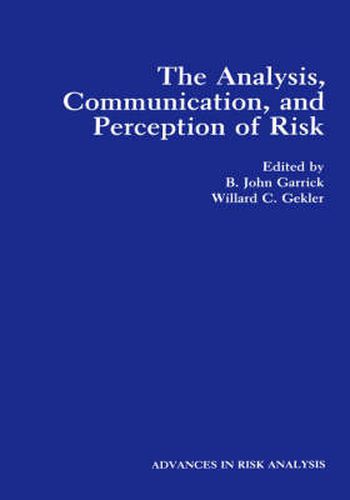
The 1989 Annual Meeting of the Society for Risk Analysis dramatically demonstrated one of the most important reasons for having the Society - to bring together people with highly diverse backgrounds and disciplines to assess the common problems of societal and individual risks. The physical scientists emphasized the analytical tools for assessing environmental effects and for modeling risks from engineered systems and other human activities. The health scientists presented numerous methods of analyzing health effects, including the subject of dose-response relationships, especially at low exposure levels - never an easy analysis. The social and political scientists concentrated on issues of risk perception, communication, acceptability, and human touch. Others discussed such issues as cost-benefit analysis and the risk-based approach to decision analysis. Use of risk assessment methods for risk management continued to be a matter of strong opinion and debate. The impacts of state and federal regulations, existing and planned, were assessed in sessions and in luncheon speeches. These impacts show that risk analysis practitioners will have an increasingly important role in the future. They will be challenged to provide clear, easily understood evaluations of risk that are responsive to society’s concern for risk, as evidenced in laws and regulations. Of course, the various risk analysis specialties overlapped in domains of interest.
$9.00 standard shipping within Australia
FREE standard shipping within Australia for orders over $100.00
Express & International shipping calculated at checkout
Stock availability can be subject to change without notice. We recommend calling the shop or contacting our online team to check availability of low stock items. Please see our Shopping Online page for more details.
This title is printed to order. This book may have been self-published. If so, we cannot guarantee the quality of the content. In the main most books will have gone through the editing process however some may not. We therefore suggest that you be aware of this before ordering this book. If in doubt check either the author or publisher’s details as we are unable to accept any returns unless they are faulty. Please contact us if you have any questions.
The 1989 Annual Meeting of the Society for Risk Analysis dramatically demonstrated one of the most important reasons for having the Society - to bring together people with highly diverse backgrounds and disciplines to assess the common problems of societal and individual risks. The physical scientists emphasized the analytical tools for assessing environmental effects and for modeling risks from engineered systems and other human activities. The health scientists presented numerous methods of analyzing health effects, including the subject of dose-response relationships, especially at low exposure levels - never an easy analysis. The social and political scientists concentrated on issues of risk perception, communication, acceptability, and human touch. Others discussed such issues as cost-benefit analysis and the risk-based approach to decision analysis. Use of risk assessment methods for risk management continued to be a matter of strong opinion and debate. The impacts of state and federal regulations, existing and planned, were assessed in sessions and in luncheon speeches. These impacts show that risk analysis practitioners will have an increasingly important role in the future. They will be challenged to provide clear, easily understood evaluations of risk that are responsive to society’s concern for risk, as evidenced in laws and regulations. Of course, the various risk analysis specialties overlapped in domains of interest.
Search our extensive online catalogue.
