Readings Newsletter
Become a Readings Member to make your shopping experience even easier.
Sign in or sign up for free!
You’re not far away from qualifying for FREE standard shipping within Australia
You’ve qualified for FREE standard shipping within Australia
The cart is loading…


This title is printed to order. This book may have been self-published. If so, we cannot guarantee the quality of the content. In the main most books will have gone through the editing process however some may not. We therefore suggest that you be aware of this before ordering this book. If in doubt check either the author or publisher’s details as we are unable to accept any returns unless they are faulty. Please contact us if you have any questions.
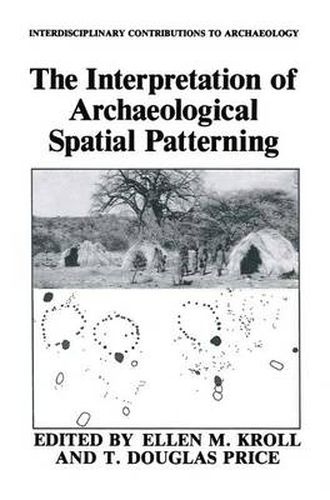
Investigations of archaeological intrasite spatial patterns have generally taken one of two directions: studies that introduced and explored methods for the analysis of archaeological spatial patterns or those that described and analyzed the for mation of spatial patterns in actuaiistic-ethnographic, experimental, or natu ral-contexts. The archaeological studies were largely quantitative in nature, concerned with the recognition and definition of patterns; the actualistic efforts were often oriented more toward interpretation, dealing with how patterns formed and what they meant. Our research group on archaeological spatial analysis at the University of Wisconsin-Madison has been working for several years on both quantitative and interpretive problems. Both lines of investigation are closely related and are important complements. In order to demonstrate the convergence of archaeological and actualistic studies for the understanding of intrasite spatial patterns, we organized a sympo sium at the 52nd Annual Meeting of the Society of American Archaeology in Toronto, Canada, in May 1987. The symposium, titled The Interpretation of Stone Age Archaeological Spatial Patterns, was organized into two sessions. The six papers presented in the morning session, five of which comprise Part I of this volume, focused on ethnoarchaeological and experimental research. Michael Schiffer was the discussant for this half of the symposium. Our intention for the ethnoarchaeological contributions to the symposium and volume was the delin eation of some of the significant accomplishments achieved thus far by actualistic studies regarding the formation of spatial patterns.
$9.00 standard shipping within Australia
FREE standard shipping within Australia for orders over $100.00
Express & International shipping calculated at checkout
Stock availability can be subject to change without notice. We recommend calling the shop or contacting our online team to check availability of low stock items. Please see our Shopping Online page for more details.
This title is printed to order. This book may have been self-published. If so, we cannot guarantee the quality of the content. In the main most books will have gone through the editing process however some may not. We therefore suggest that you be aware of this before ordering this book. If in doubt check either the author or publisher’s details as we are unable to accept any returns unless they are faulty. Please contact us if you have any questions.
Investigations of archaeological intrasite spatial patterns have generally taken one of two directions: studies that introduced and explored methods for the analysis of archaeological spatial patterns or those that described and analyzed the for mation of spatial patterns in actuaiistic-ethnographic, experimental, or natu ral-contexts. The archaeological studies were largely quantitative in nature, concerned with the recognition and definition of patterns; the actualistic efforts were often oriented more toward interpretation, dealing with how patterns formed and what they meant. Our research group on archaeological spatial analysis at the University of Wisconsin-Madison has been working for several years on both quantitative and interpretive problems. Both lines of investigation are closely related and are important complements. In order to demonstrate the convergence of archaeological and actualistic studies for the understanding of intrasite spatial patterns, we organized a sympo sium at the 52nd Annual Meeting of the Society of American Archaeology in Toronto, Canada, in May 1987. The symposium, titled The Interpretation of Stone Age Archaeological Spatial Patterns, was organized into two sessions. The six papers presented in the morning session, five of which comprise Part I of this volume, focused on ethnoarchaeological and experimental research. Michael Schiffer was the discussant for this half of the symposium. Our intention for the ethnoarchaeological contributions to the symposium and volume was the delin eation of some of the significant accomplishments achieved thus far by actualistic studies regarding the formation of spatial patterns.
Search our extensive online catalogue.
