Readings Newsletter
Become a Readings Member to make your shopping experience even easier.
Sign in or sign up for free!
You’re not far away from qualifying for FREE standard shipping within Australia
You’ve qualified for FREE standard shipping within Australia
The cart is loading…


This title is printed to order. This book may have been self-published. If so, we cannot guarantee the quality of the content. In the main most books will have gone through the editing process however some may not. We therefore suggest that you be aware of this before ordering this book. If in doubt check either the author or publisher’s details as we are unable to accept any returns unless they are faulty. Please contact us if you have any questions.
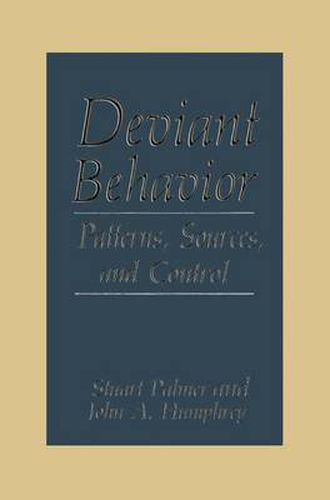
This book is for the student in the introductory course on deviant be havior and in related courses. A wide range of ideas and facts is set forth in a way that should be comprehensible to the student without prior knowledge of this area of study. In Chapter 1, The Nature of Deviance, various ways of defining deviance are explored and one is settled upon: Deviance is behavior that is unusual, not typical, in a society or group. Chapter 2 is devoted to a preliminary consideration of several main currents of social thought that seek to explain why deviance comes about and is perpetrated. These explanations fall into four broad theo retical categories. First, there are those theories that view the major sources of deviance as having to do with the extent to which individ uals are bound into or dissociated from the group; these are termed social integration theories. Second, there are the cultural support the ories, which specify that there are subcultures of deviance, that is, bod ies of customs and values that advocate a given form of deviance and are socially transmitted from one person to another through the learn ing process. Third, there are social disorganization and conflict theo ries, which focus on the ways in which a lack of group organization and the presence of broad social and cultural conflicts bring about de viance.
$9.00 standard shipping within Australia
FREE standard shipping within Australia for orders over $100.00
Express & International shipping calculated at checkout
Stock availability can be subject to change without notice. We recommend calling the shop or contacting our online team to check availability of low stock items. Please see our Shopping Online page for more details.
This title is printed to order. This book may have been self-published. If so, we cannot guarantee the quality of the content. In the main most books will have gone through the editing process however some may not. We therefore suggest that you be aware of this before ordering this book. If in doubt check either the author or publisher’s details as we are unable to accept any returns unless they are faulty. Please contact us if you have any questions.
This book is for the student in the introductory course on deviant be havior and in related courses. A wide range of ideas and facts is set forth in a way that should be comprehensible to the student without prior knowledge of this area of study. In Chapter 1, The Nature of Deviance, various ways of defining deviance are explored and one is settled upon: Deviance is behavior that is unusual, not typical, in a society or group. Chapter 2 is devoted to a preliminary consideration of several main currents of social thought that seek to explain why deviance comes about and is perpetrated. These explanations fall into four broad theo retical categories. First, there are those theories that view the major sources of deviance as having to do with the extent to which individ uals are bound into or dissociated from the group; these are termed social integration theories. Second, there are the cultural support the ories, which specify that there are subcultures of deviance, that is, bod ies of customs and values that advocate a given form of deviance and are socially transmitted from one person to another through the learn ing process. Third, there are social disorganization and conflict theo ries, which focus on the ways in which a lack of group organization and the presence of broad social and cultural conflicts bring about de viance.
Search our extensive online catalogue.
