Readings Newsletter
Become a Readings Member to make your shopping experience even easier.
Sign in or sign up for free!
You’re not far away from qualifying for FREE standard shipping within Australia
You’ve qualified for FREE standard shipping within Australia
The cart is loading…


This title is printed to order. This book may have been self-published. If so, we cannot guarantee the quality of the content. In the main most books will have gone through the editing process however some may not. We therefore suggest that you be aware of this before ordering this book. If in doubt check either the author or publisher’s details as we are unable to accept any returns unless they are faulty. Please contact us if you have any questions.
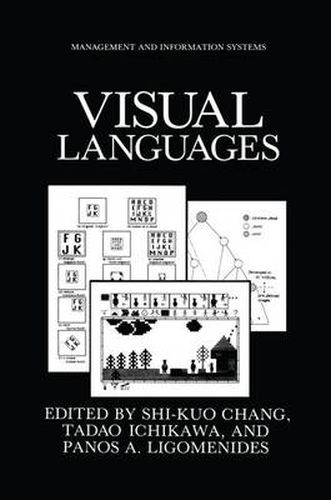
This book is intended as both an introduction to the state-of-the-art in visual languages, as well as an exposition of the frontiers of research in advanced visual languages. It is for computer scientists, computer engi neers, information scientists, application programmers, and technical managers responsible for software development projects who are inter ested in the methodology and manifold applications of visual languages and visual programming. The contents of this book are drawn from invited papers, as well as selected papers from two workshops: the 1985 IEEE Workshop on Lan guages for Automation-Cognitive Aspects in Information Processing, which was held in Mallorca, Spain, June 28-30, 1985; and the 1984 IEEE Workshop on Visual Languages, which was held in Hiroshima, Japan, December 7-9, 1984. Panos Ligomenides and I organized the technical program of LFA ‘85, and Tadao Ichikawa and I organized the techni cal program of VL '84. Both workshops have now become successful annual events in their own right. The intersecting area of visual languages and visual programming especially has become a fascinating new research area. It is hoped that this book will focus the reader’s attention on some of the interesting research issues as well as the potential for future applications. After reading this book, the reader will undoubtedly get an impression that visual languages and the concept of generalized icons can be studied fruitfully from many different perspectives, including computer graphics, formal language theory, educational methodology, cognitive psychology and visual design.
$9.00 standard shipping within Australia
FREE standard shipping within Australia for orders over $100.00
Express & International shipping calculated at checkout
Stock availability can be subject to change without notice. We recommend calling the shop or contacting our online team to check availability of low stock items. Please see our Shopping Online page for more details.
This title is printed to order. This book may have been self-published. If so, we cannot guarantee the quality of the content. In the main most books will have gone through the editing process however some may not. We therefore suggest that you be aware of this before ordering this book. If in doubt check either the author or publisher’s details as we are unable to accept any returns unless they are faulty. Please contact us if you have any questions.
This book is intended as both an introduction to the state-of-the-art in visual languages, as well as an exposition of the frontiers of research in advanced visual languages. It is for computer scientists, computer engi neers, information scientists, application programmers, and technical managers responsible for software development projects who are inter ested in the methodology and manifold applications of visual languages and visual programming. The contents of this book are drawn from invited papers, as well as selected papers from two workshops: the 1985 IEEE Workshop on Lan guages for Automation-Cognitive Aspects in Information Processing, which was held in Mallorca, Spain, June 28-30, 1985; and the 1984 IEEE Workshop on Visual Languages, which was held in Hiroshima, Japan, December 7-9, 1984. Panos Ligomenides and I organized the technical program of LFA ‘85, and Tadao Ichikawa and I organized the techni cal program of VL '84. Both workshops have now become successful annual events in their own right. The intersecting area of visual languages and visual programming especially has become a fascinating new research area. It is hoped that this book will focus the reader’s attention on some of the interesting research issues as well as the potential for future applications. After reading this book, the reader will undoubtedly get an impression that visual languages and the concept of generalized icons can be studied fruitfully from many different perspectives, including computer graphics, formal language theory, educational methodology, cognitive psychology and visual design.
Search our extensive online catalogue.
