Readings Newsletter
Become a Readings Member to make your shopping experience even easier.
Sign in or sign up for free!
You’re not far away from qualifying for FREE standard shipping within Australia
You’ve qualified for FREE standard shipping within Australia
The cart is loading…


This title is printed to order. This book may have been self-published. If so, we cannot guarantee the quality of the content. In the main most books will have gone through the editing process however some may not. We therefore suggest that you be aware of this before ordering this book. If in doubt check either the author or publisher’s details as we are unable to accept any returns unless they are faulty. Please contact us if you have any questions.
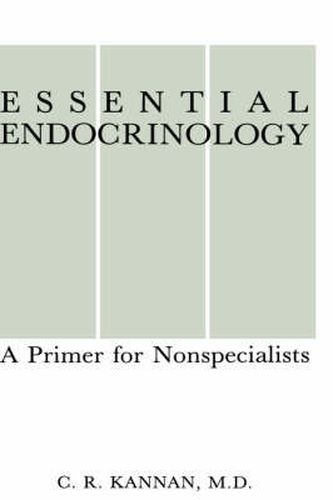
This work, Essential Endocrinology: A Primer for Nonspecialists, is written with dual purposes in mind: first, to provide a framework of basic endocrinology and diabetology to the medical student, and second, to provide a quick, con cise, and handy guide to the junior residents in their early years of training who wish to obtain a working knowledge about endocrine disorders that affect their patients. One of the outstanding advantages of being a teacher of en docrinology to students and junior residents is that it bestows a perspective from a unique vantage point. Books written for the junior members of our profession have suffered from extremes of caliber, ranging from excellence beyond their comprehension to insufferable mediocrity. Textbooks in en docrinology that are simple enough to cover the principles of that speciality and yet comprehensive enough without treading into controversial quicksand are few and far between. This book is aimed at filling that gap and is written with no other criterion than simplifying a complex subject matter. From this touchstone, the work has never really departed. A decade of experience as a teacher and physician in the field of endo crinologyhas impressed on me that the process of simplification rests on four basic principles: an understanding of endocrine concepts, the application of these concepts to the understanding of diseases, the transference of knowl edge to clinical situations, and the integration of the patient with the labo ratory, the ultimate testing ground where clinical diagnoses stand or fall.
$9.00 standard shipping within Australia
FREE standard shipping within Australia for orders over $100.00
Express & International shipping calculated at checkout
Stock availability can be subject to change without notice. We recommend calling the shop or contacting our online team to check availability of low stock items. Please see our Shopping Online page for more details.
This title is printed to order. This book may have been self-published. If so, we cannot guarantee the quality of the content. In the main most books will have gone through the editing process however some may not. We therefore suggest that you be aware of this before ordering this book. If in doubt check either the author or publisher’s details as we are unable to accept any returns unless they are faulty. Please contact us if you have any questions.
This work, Essential Endocrinology: A Primer for Nonspecialists, is written with dual purposes in mind: first, to provide a framework of basic endocrinology and diabetology to the medical student, and second, to provide a quick, con cise, and handy guide to the junior residents in their early years of training who wish to obtain a working knowledge about endocrine disorders that affect their patients. One of the outstanding advantages of being a teacher of en docrinology to students and junior residents is that it bestows a perspective from a unique vantage point. Books written for the junior members of our profession have suffered from extremes of caliber, ranging from excellence beyond their comprehension to insufferable mediocrity. Textbooks in en docrinology that are simple enough to cover the principles of that speciality and yet comprehensive enough without treading into controversial quicksand are few and far between. This book is aimed at filling that gap and is written with no other criterion than simplifying a complex subject matter. From this touchstone, the work has never really departed. A decade of experience as a teacher and physician in the field of endo crinologyhas impressed on me that the process of simplification rests on four basic principles: an understanding of endocrine concepts, the application of these concepts to the understanding of diseases, the transference of knowl edge to clinical situations, and the integration of the patient with the labo ratory, the ultimate testing ground where clinical diagnoses stand or fall.
Search our extensive online catalogue.
