Readings Newsletter
Become a Readings Member to make your shopping experience even easier.
Sign in or sign up for free!
You’re not far away from qualifying for FREE standard shipping within Australia
You’ve qualified for FREE standard shipping within Australia
The cart is loading…


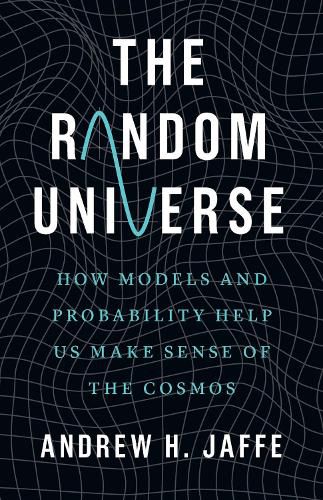
An award-winning astrophysicist looks at how the understanding of uncertainty and randomness has led to breakthroughs in our knowledge of the cosmos
All of us understand the world around us by constructing models, comparing them to observations, and drawing conclusions. Scientists create, test, and replace these models by applying the twinned concepts of probability and randomness. Exploring how this process has refined our knowledge of quantum mechanics and the birth of the universe, Andrew H. Jaffe offers a unique synthesis of the philosophy of epistemology, the mathematics of probability, and the science of cosmology.
As Jaffe puts Enlightenment thinkers like David Hume in conversation with contemporary philosophers such as Karl Popper and Imre Lakatos and engages with scientists ranging from Isaac Newton and Galileo to Albert Einstein and Arthur Eddington, he uses Thomas Bayes's seminal studies of statistics and probability to make sense of conflicting currents of thought. This is a deep look into how we have learned to account for uncertainty in our search for knowledge-and a reminder that science is not about facts and data as such but about creating models that correctly account for the facts and data.
$9.00 standard shipping within Australia
FREE standard shipping within Australia for orders over $100.00
Express & International shipping calculated at checkout
Stock availability can be subject to change without notice. We recommend calling the shop or contacting our online team to check availability of low stock items. Please see our Shopping Online page for more details.
An award-winning astrophysicist looks at how the understanding of uncertainty and randomness has led to breakthroughs in our knowledge of the cosmos
All of us understand the world around us by constructing models, comparing them to observations, and drawing conclusions. Scientists create, test, and replace these models by applying the twinned concepts of probability and randomness. Exploring how this process has refined our knowledge of quantum mechanics and the birth of the universe, Andrew H. Jaffe offers a unique synthesis of the philosophy of epistemology, the mathematics of probability, and the science of cosmology.
As Jaffe puts Enlightenment thinkers like David Hume in conversation with contemporary philosophers such as Karl Popper and Imre Lakatos and engages with scientists ranging from Isaac Newton and Galileo to Albert Einstein and Arthur Eddington, he uses Thomas Bayes's seminal studies of statistics and probability to make sense of conflicting currents of thought. This is a deep look into how we have learned to account for uncertainty in our search for knowledge-and a reminder that science is not about facts and data as such but about creating models that correctly account for the facts and data.
Search our extensive online catalogue.
